



Hey, it’s Marc & the 51 team,
Before we get into this week’s signals, one thing worth flagging at the top.
Karl from Proof of Talk pitched 51 as official research partner for June 2-3. My instinct was to decline. But I met this team for the first time 4 years ago at in Paris, just before they launched. And they've built it into one of the top digital asset conferences of the year:
2,500 attendees from banking, regulation, and institutional capital. 95% C-suite. Zero pay-to-speak.
So we said yes.
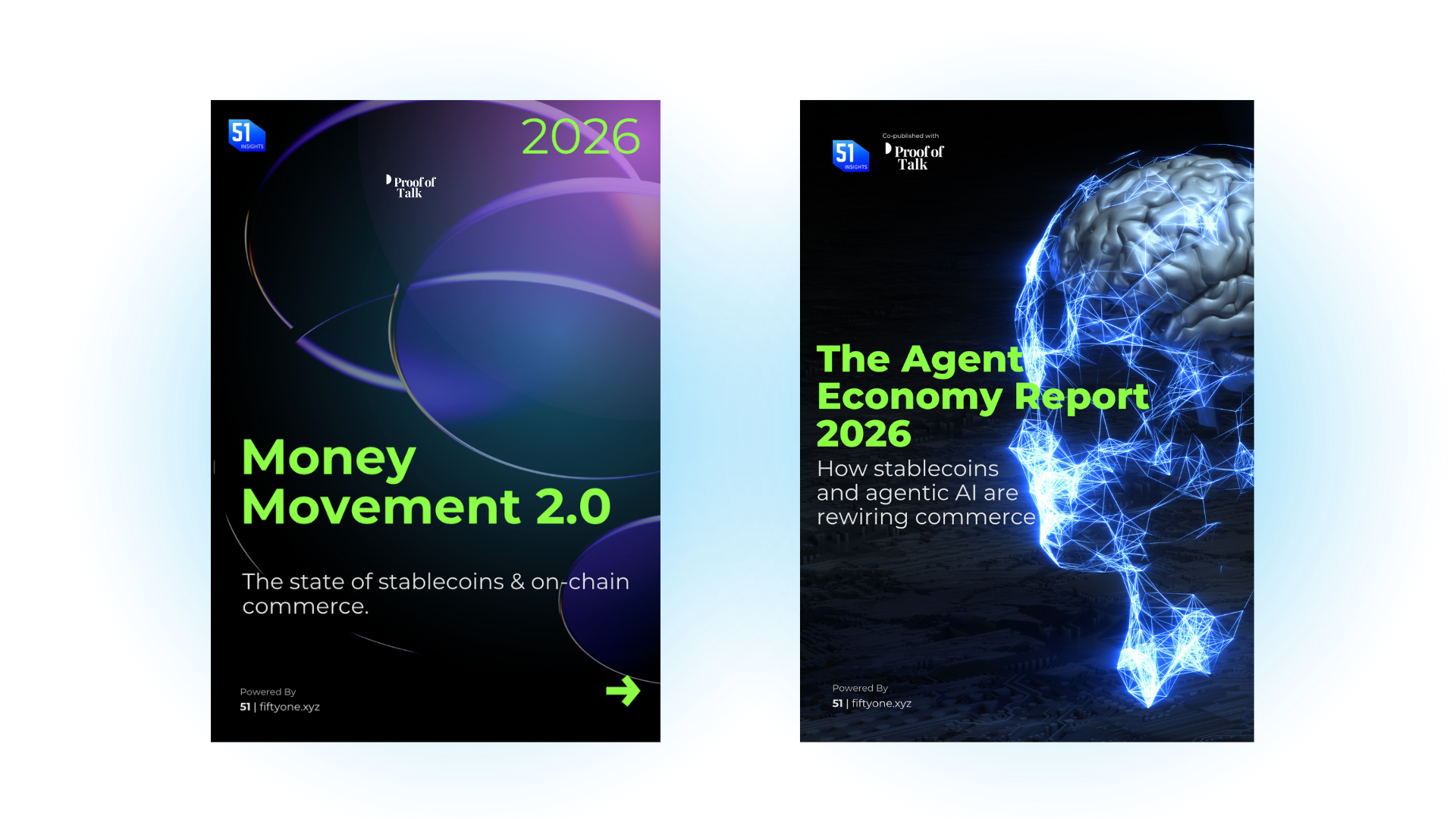
We’re producing two reports as the official research partners: 1) Money Movement 2.0: State of Stablecoins and 2) The Agent Economy 2026, second editions after last year’s became one of our most-read reports of 2025.
👉 3-5 partner slots open for companies that belong in the conversation.
The report goes to every attendee via email and print and hits our 100K+ institutional audience in the week of the event, and lives on our socials for months.
If you run marketing or BD at a stablecoin issuer, custody platform, or B2B fintech, reply to this email. 15 minutes, I’ll tell you if it’s the right fit.
Now to this week’s signals 👇
I’ve tracked every SEC rule change this year. None of them prepared me for this one:
Anthropic tried to disown tokenized versions of its own stock last week. It couldn’t pull them off Solana.
The SEC is about to make that the default for every blue chip on a US exchange.
CLARITY, PARITY Act, and American Reserve Modernization Act (ARMA) are all moving through Congress this month. Trump just signed an EO ordering federal regulators to identify barriers to fintech and crypto. The door isn’t opening anymore. It’s open.
Here’s what else moved this week:
VanEck and Grayscale file Binance ETF
Qivalis hits Europe’s 37 banks
Basel walks back its 2022 crypto rules
Ripple Prime + EDX go live
Standard Chartered acquired Zodia
And 15+ more signals. Let’s jump in 👇🌆
Top Boardroom Reads
Digital Asset Playbook (BCG)
8 of 9 recessions called, now he’s calling bitcoin, with Cam Harvey, Economist (51)
Consultation Paper on the Prudential Treatment of Cryptoassets on Permissionless Blockchains (MAS)
How AI is rewiring global trade (Allianz)
Quantum’s bold promise: What business leaders need to know (Mckinsey)
Stablecoins in Africa (DCI)
GenAI in central banking (SUERF)
Top Signals This Week
SEC will let DeFi trade stocks
On May 18, Bloomberg reported that the SEC is preparing to release its long-signaled Innovation Exemption for tokenized securities. The framework allows digital tokens linked to public-company shares, including tokens issued by third parties without the underlying company’s consent, to trade on decentralized platforms and automated market makers under lighter-touch registration. [NEWS]
Why it matters: Issuer consent just died. The 1933 Securities Act gave public companies veto power over where their stock trades. The Innovation Exemption removes it. That rule lasted 93 years.
Here’s how it works in practice. Backed Finance wraps AAPL, NVDA, or TSLA, sells SPL-token versions on Solana, and Apple has no recourse. The token settles against real shares Backed holds in a regulated brokerage account. Shareholder rights route through Broadridge’s ProxyVote platform. Superstate and Ondo already pass through votes and dividends.
Be smart: Anthropic figured this out last week. It publicly disowned tokenized versions of its own stock. The tokens kept trading. Every blue chip on a US exchange will face the same problem.
Wall Street pushed back: traditional exchange representatives, including the World Federation of Exchanges, warned the framework creates a regulatory shortcut for crypto platforms, forcing the SEC to delay its plans.

🚨 The Friday newsletter only scratches the surface. A lot more is going on that we’ll tell you in our PRO briefings.
VanEck and Grayscale filed for Binance ETF
On 15 May 2026, VanEck filed Amendment No. 5 to its Form S-1 for the VanEck BNB ETF (Nasdaq under ticker VBNB). The same day, Grayscale filed Amendment No. 2 to its competing BNB ETF registration, slated to list as GBNB. VanEck disclosed a 0.39% management fee; Grayscale has not yet published one.[NEWS]
Why it matters: Altcoin ETFs used to mean fighting the SEC over fund architecture. Now you just swap the ticker. Bitcoin and Ether ETFs already cleared the legal framework. BNB inherits it. One detail makes this bigger. The SEC dropped the Rule 19b-4 requirement for every individual crypto ETP. Generic listing standards now apply across the category. That bottleneck is gone. Notice what the issuers are doing in response. They’re not arguing anymore. VanEck compromised early on staking yield to preserve speed-to-market. Grayscale followed. The race stopped being about winning the regulatory argument. It became about being first to file the next altcoin.

Qivalis hits Europe’s 37 banks
On May 20, Qivalis announced a 25-bank expansion that takes the consortium from 12 founding members to 37. Spain led the new wave with five additions: ABANCA, Banco Sabadell, Bankinter, Cecabank and Kutxabank. France, Sweden, Greece, the Netherlands, Finland and Ireland each contributed two new institutions. Italy added BPER and Intesa Sanpaolo to founding member UniCredit. Iceland, Luxembourg, Poland and Austria entered the consortium for the first time via Landsbankinn, Banque et Caisse d’Épargne de l’État, Bank Pekao S.A. and Erste Group respectively.
Why it matters: Europe’s biggest euro stablecoin is American. Circle’s EURC controls roughly half the market at ~$438M. Société Générale’s EURCV sits at ~$123M. That’s the entire institutional euro stablecoin space, ~$560M combined. Both numbers are rounding errors against the $323B total stablecoin market. Spain is now the leading retail market for EURC in Europe. Think about what that means. Spanish savers are choosing a Boston-based issuer over their own banks for digital euros.
That’s what dragged 25 new banks into Qivalis in one announcement. They’re not building this because they want to. They’re building it because they’re losing.
Basel walks back its 2022 crypto rules
On May 20, BIS published a press release confirming progress on the expedited targeted review of SCO60, its prudential standard for banks’ cryptoasset exposures. The standard came into force on 1 January 2026 after being deferred from 2025 under industry pressure. Its centerpiece, a 1,250% risk weight on Group 2b cryptoassets (which captures virtually every stablecoin issued on a permissionless chain, including USDC and USDT), functions as a near-total ban on bank balance sheet exposure. [RELEASE]
Why it matters: Basel set the 1,250% risk weight in December 2022. Bitcoin was the frame back then. Every dollar of crypto on a bank’s balance sheet required a dollar of CET1 capital. The rule did exactly what it was designed to do: keep banks out. The world doesn’t look like December 2022 anymore. Three of the four largest US banks have on-chain dollar products live. Stablecoins crossed $323B. Tokenized money market funds keep growing. The rule designed to slow banks down is now blocking them from a market they want to enter. Banks don’t lobby Basel to walk back their own rules unless they’re ready to deploy capital. This is what that looks like.
🚨 Want more intelligence and understand what this means for your institution? Subscribe to PRO below:
EDX just became Ripple Prime’s liquidity spine
On May 19, Ripple Prime, the rebranded Hidden Road (acquired for $1.25B), has plugged into EDX Markets’ US spot venue and EDXM International’s Singapore perpetual futures exchange. Clients can now route spot and perps through EDX while financing, clearing, and net-settling across the rest of their book through Ripple Prime. Backed by Citadel Securities, Virtu, Fidelity Digital Assets, Charles Schwab, Sequoia, HRT, and Miami International Holdings, EDX Markets ran roughly $200M in average daily spot volume by December 2025 and applied for an OCC national trust bank charter in April. [RELEASE]
Why it matters: Crypto’s prime brokerage market is splitting in two: conflicted and non-conflicted and Ripple is the second one. Coinbase Prime is the obvious incumbent: $236B quarterly trading volume, $300B in assets under custody, 80%+ of US bitcoin and ether ETF custody. But Coinbase Prime is vertically integrated, clients route flow through Coinbase the exchange. EDX applied for an OCC trust bank charter in April. That looked like a move to give institutional clients an alternative venue. This week's deal completes the picture. Ripple Prime becomes the credit layer. Clients face EDX, CME, Hyperliquid, and OTC desks under one collateral pool. No conflict, because the credit provider doesn't run the exchange.
The bet: institutions will pay for separation of powers.


Standard Chartered acquired Zodia
On 18 May 2026, Standard Chartered confirmed that minority Zodia shareholders had accepted its non-binding offer to consolidate the custodian’s regulated activities into the bank itself. The Financing and Securities Services (FSS) division, which already operates Standard Chartered’s internal digital asset custody platform, will absorb Zodia’s licensed custody book.
Why it matters: The joint venture model just died. We're past pilots and experiments. Asset managers need real custody at scale, and banks want to own the rails themselves. Standard Chartered absorbing Zodia into FSS isn’t an org chart change. It bundles custody with the things only a bank can offer: collateral mobility, capital introductions, FX, and intraday financing against tokenized positions. A standalone custodian can’t compete with that stack.
Be smart: Expect Fireblocks, BitGo, and Anchorage to face the same compression. Either get acquired or get out-bundled.

Other Signals
Infrastructure and Markets
Coinbase Derivatives is launching perpetual-style futures contracts tracking the top 100 Nasdaq firms and three thematic equity indexes: AI, China, and US national security. Link
On-chain perpetuals exchange Ostium partnered with Nasdaq to integrate the exchange operator’s equities data into its trading venue. Link
Regulation and Policy
Rep. Nick Begich introduced the American Reserve Modernization Act to create a permanent, legally codified U.S. strategic Bitcoin reserve. Link
The White House has cleared major legal hurdles to operationalize the U.S. Strategic Bitcoin Reserve. Link
The FCA and Bank of England launched a joint consultation to gather industry feedback on regulating tokenized wholesale financial markets in the UK. Link
Banking and Payments
Boerse Stuttgart’s Seturion partnered with Societe Generale and flatexDEGIRO to build a pan-European blockchain securities settlement system. Link
Kraken’s parent company, Payward, secured preliminary approval from Dubai’s VARA for a broker-dealer, investment, and management license. Link
Zero Hash secured an Electronic Money Institution (EMI) license from the Dutch central bank, becoming the first firm under MiCA to hold full EMI status. Link
The New York State Department of Financial Services (NYDFS) granted GalaxyOne Prime NY a BitLicense and Money Transmission License. Link
Funds, Deals and others
SpaceX officially filed its S-1 with the SEC for an anticipated June Nasdaq listing, targeting a $1.75T valuation and an $80B raise. Link
SpaceX disclosed it holds $1.45B worth of Bitcoin on its balance sheet. Link
Tether acquired SoftBank’s equity stake in Twenty One Capital (XXI). Link
Securitize announced record Q1 2026 revenue of $19.5M, a 39% YoY. Link
Bitmine disclosed that as of the prior afternoon it held 5,278,462 ETH at $2,191 per token, 202 BTC, $685M cash, a $200M stake in Beast Industries, and $83M in Eightco Holdings (NASDAQ: ORBS). Link
That’s all for now, folks.
PRO Readers: Read our alpha insights below!
– Marc & Team


