



Hey, it’s Marc & the 51 team.
I’ve watched banks lobby Washington for 100 years to keep their Fed access exclusive. This week, Deutsche Börse skipped the lobby and bought a seat.
Deutsche Börse paid $200M for a 1.5% stake in Kraken, hours before Kraken confirmed it filed for a US IPO. The real story wasn’t the valuation discount. It’s what Kraken’s Kansas City Fed account gives Deutsche Börse: a pipe into Fedwire that makes correspondent banks optional.
Meanwhile, Lummis says CLARITY dies if it doesn't pass now:
“This is our last chance to pass the Clarity Act until at least 2030. We can’t afford to surrender America’s financial future.”
Here’s what we’re covering:
Deutsche Börse front-runs Kraken IPO with $200M stake
Goldman Sachs files first-ever Bitcoin ETF
Charles Schwab launches spot crypto trading for 39 million accounts
UBS leads Swiss Banks into live CHF Stablecoin pilot
Visa is building to replace Visa
HSBC takes Stablecoin stack public on Canton blockchain
Ripple lands Kyobo to tokenize Korean Sovereign Bond
ECB undercuts US Stablecoin model with tokenization terms
And 15+ more signals. Let’s jump in 👇
Exclusive for 51 Readers:
👉 Register for Consensus Miami May 5-7, 2026, and get in the room where the people moving that money actually meet. Use this for up to $200 off:
🎟️ 20% Discount Code: MARC
🔗 Auto-applied discount link: https://go.coindesk.com/3NLCAAd
Top Boardroom Reads
SoK: Blockchain Agent-to-Agent Payments (Research Paper)
Detangling Tokenization of RWAs (Franklin Templeton)
Stablecoin Issuance Market: Four Business Models Reshaping the Market (Tiger Research)
Institutional Infrastructure for Global Settlement and Tokenized Assets (Allium)
Tokenization of Financial Assets (IOSCO)
The Friday newsletter only scratches the surface. A lot more is going on that we’ll tell you in our PRO briefings.
Top Signals This Week
Deutsche Börse front-runs Kraken IPO with $200M stake
On April 14, 2026, Deutsche Börse announced it acquired a 1.5% fully diluted stake in Kraken (Payward Inc.), for $200M in a secondary share transaction. The deal implies a $13.3B valuation, down from the $20B Kraken printed in its November 2025 $800M raise. It closes before June. [RELEASE]
Hours later, Kraken co-CEO Arjun Sethi confirmed at Semafor’s World Economy Summit that Kraken has confidentially filed for a US IPO. [NEWS]
Why it matters: Through Kraken, Deutsche Börse bought a pipe directly into the U.S. central bank. Kraken’s “limited purpose” account can’t earn interest, can’t touch the discount window or FedNow, but it can settle on Fedwire. That’s the only access institutional wholesale fiat flows actually need. Correspondent banks exist solely to provide this. Kraken just made them optional, and banks are lobbying against it. The Bank Policy Institute called the Kansas City Fed’s decision a “front-run” of the Fed Board’s public comment process. Also, Deutsche Börse stepped in between Kraken’s November raise and IPO filing and captured a 1.5% secondary position.

🚀 Build credibility. Drive pipeline. Win in digital assets. We produce institutional-grade research that positions you as the authority in your category, then distribute it to 100K+ decision-makers who act on what we publish.[let's talk →].

Goldman Sachs files first-ever Bitcoin ETF
On April 14, Goldman Sachs filed with the SEC for the Goldman Sachs Bitcoin Premium Income ETF, a covered-call strategy that buys shares of existing spot Bitcoin ETFs (BlackRock’s IBIT, Fidelity’s FBTC) and systematically sells call options against them to generate income. The earliest possible launch is late June, assuming no SEC objections. Management fee has not been disclosed. BlackRock’s competing product, the iShares Bitcoin Premium Income ETF (BITA), is further along and expected to launch within weeks. [NEWS]
Why it matters: Goldman filing its first Bitcoin ETF product is the signal, not the product itself. The covered-call wrapper turns Bitcoin volatility into yield, which makes BTC palatable to the exact investors who would never buy spot: retirees, endowments, conservative allocators, and the wealth management channels Goldman dominates. Fortune called it “boomer candy” and the label fits. The 40-100% overlay range gives Goldman unusual flexibility to toggle between aggressive and defensive positioning depending on vol regime. This is Wall Street domesticating Bitcoin into a familiar income product. The competitive race is now Goldman vs. BlackRock on who captures yield-hungry capital first.
Charles Schwab launches spot crypto trading for 39 million accounts
On April 16, Charles Schwab announced Schwab Crypto, a direct spot trading product for Bitcoin and Ethereum rolling out “in the coming weeks.” The product runs through Paxos, which handles both sub-custody and trade execution. Schwab is pricing trades at 75 basis points per transaction, undercutting Fidelity Crypto (100 bps) while sitting above Robinhood’s tightest spreads. [RELEASE]
Why it matters: Schwab manages $12 trillion in client assets across 39 million accounts. That makes it the largest traditional brokerage to offer direct spot crypto trading. When $12T in AUM gets a “buy Bitcoin” button in the same interface where clients hold their index funds, the distribution math changes. Schwab isn’t competing with Coinbase. It’s competing with the reason most traditional investors never bought crypto in the first place: friction.
UBS leads Swiss Banks into live CHF Stablecoin pilot
On April 8, UBS, PostFinance, Sygnum, Raiffeisen, Zürcher Kantonalbank, and BCV launched a joint CHF stablecoin sandbox. The CHF (Swiss Franc Stablecoin) sandbox is a controlled live environment. The six banks with technical infrastructure from Swiss Stablecoin AG, will test real payment flows with real counterparties under transaction caps and a restricted participant pool. The sandbox runs through 2026 and remains open to additional banks and corporations. [RELEASE]
Why it matters: UBS, Switzerland’s largest bank, with $5.7T in invested assets, brings credibility to this sandbox. It has spent three years building tokenization infrastructure through UBS Tokenize, UBS Digital Cash (adopted by Ant International) and its Money Market Investment Fund (uMINT). Additionally, it joined a major Bank for International Settlements (BIS) initiative, Project Agora and is currently an active partner of MAS Singapore’s Project Guardian. Even in the blockchain space, it has achieved multiple milestones. A CHF stablecoin plugs directly into that stack. It gives UBS clients a settlement token for tokenized assets, FX, and intraday liquidity, without routing through a US-issued stablecoin.
Also: On April 9, ClearBank Europe secured CASP status from the Dutch Authority for the Financial Markets, becoming the first Dutch credit institution to complete MiCAR notification. [RELEASE]
🚨 Want more intelligence and understand what this means for your institution? Subscribe to PRO below:
Visa is building to replace Visa
On April 14, 2026, Visa, Stripe, and Standard Chartered–backed Zodia Custody went live as the first external validators on Tempo, a payments-first Layer 1 co-founded by Stripe and venture firm Paradigm. Tempo raised $500M at a $5B valuation in late 2025, ran a public testnet starting December 9, 2025, and went to mainnet in March 2026. Reportedly, Visa configured and managed the validator entirely in-house after six months of joint engineering work with Tempo’s team. [NEWS]
Why it matters: The usual story with incumbents is they watch disruption coming and freeze, because the new thing looks too small and too unprofitable to matter. Tempo fits that description perfectly. Near-zero liquidity on day one. A testnet that opened in December. Valued at $5B against a stablecoin market that’s already $318.6B. Visa signed up anyway. The math is simple. If Tempo works, Visa is inside the validator set with governance influence and a direct view of flow. If Tempo fails, Visa spent a few engineers and a press release. Against a $700B revenue franchise, that’s the cheapest insurance policy anyone has ever written.


HSBC takes Stablecoin stack public on Canton blockchain
HSBC tested its Tokenised Deposit Service (TDS) on the Canton Network, a public Layer 1 blockchain designed to connect institutional permissioned ledgers with privacy guarantees. The pilot simulated three core functions: issuance of tokenised deposits, peer-to-peer transfer between wallets, and atomic settlement against other digital assets. This was the first time HSBC deployed its TDS on a public blockchain environment. [NEWS]
On 10 April 2026, the HKMA granted HSBC a license FRS02 under Hong Kong’s Stablecoins Ordinance, alongside Anchorpoint Financial (a Standard Chartered / Animoca Brands / HKT joint venture). Only 2 out of 36 applicants cleared the bar.
Scale: TDS now processes five currencies (HKD, USD, SGD, EUR, GBP) and is expanding to the US and UAE in H1 2026.
Why it matters: Before April 10, HSBC’s tokenized deposits were corporate-only instruments: programmable bank money for treasury management, cross-border settlement, and interbank transfers. Powerful, but narrow. The FRS02 stablecoin license blows the aperture wide open. HSBC will embed an HKD stablecoin directly into PayMe, reaching 7M retail users. Every token will be fully backed by liquid assets held in segregated accounts.
What’s next: HSBC plans to launch an HKD-denominated stablecoin in H2 2026, integrated directly into PayMe (7M+ users) and the HSBC HK mobile banking app.

Ripple lands Kyobo to tokenize Korean Sovereign Bond
On April 15, 2026, Ripple signed a strategic partnership with Kyobo Life Insurance, one of South Korea’s largest insurers, to enable tokenized Korean government bond settlement. It is Ripple’s first collaboration with a major insurance institution in Korea. Transactions will run through Ripple Custody, the firm’s institutional digital asset platform. [RELEASE]
Why it matters: Insurers are the patient capital of Asia’s bond markets. When a top-three Korean life insurer agrees to settle sovereign debt on Ripple’s custody stack, it is a procurement decision. Kyobo manages long-duration assets measured in tens of trillions of won, and Korean Treasury bonds are the anchor of that book. This is also one of Ripple’s biggest steps into the institutional blockchain space.

ECB undercuts US Stablecoin model with tokenization terms
The ECB doesn't endorse technology often. This week it endorsed tokenization, with one condition: central bank money sits at the bottom of every settlement stack. Privately issued stablecoins don't qualify. Tokenized bank deposits don't qualify. The euro has to be euro all the way down. The Bulletin covered tokenized bonds, tokenized money market funds, and euro-denominated stablecoins under MiCA, noting early evidence that tokenized bonds already show lower borrowing costs and tighter bid-ask spreads than their traditional counterparts. [Bulletin]
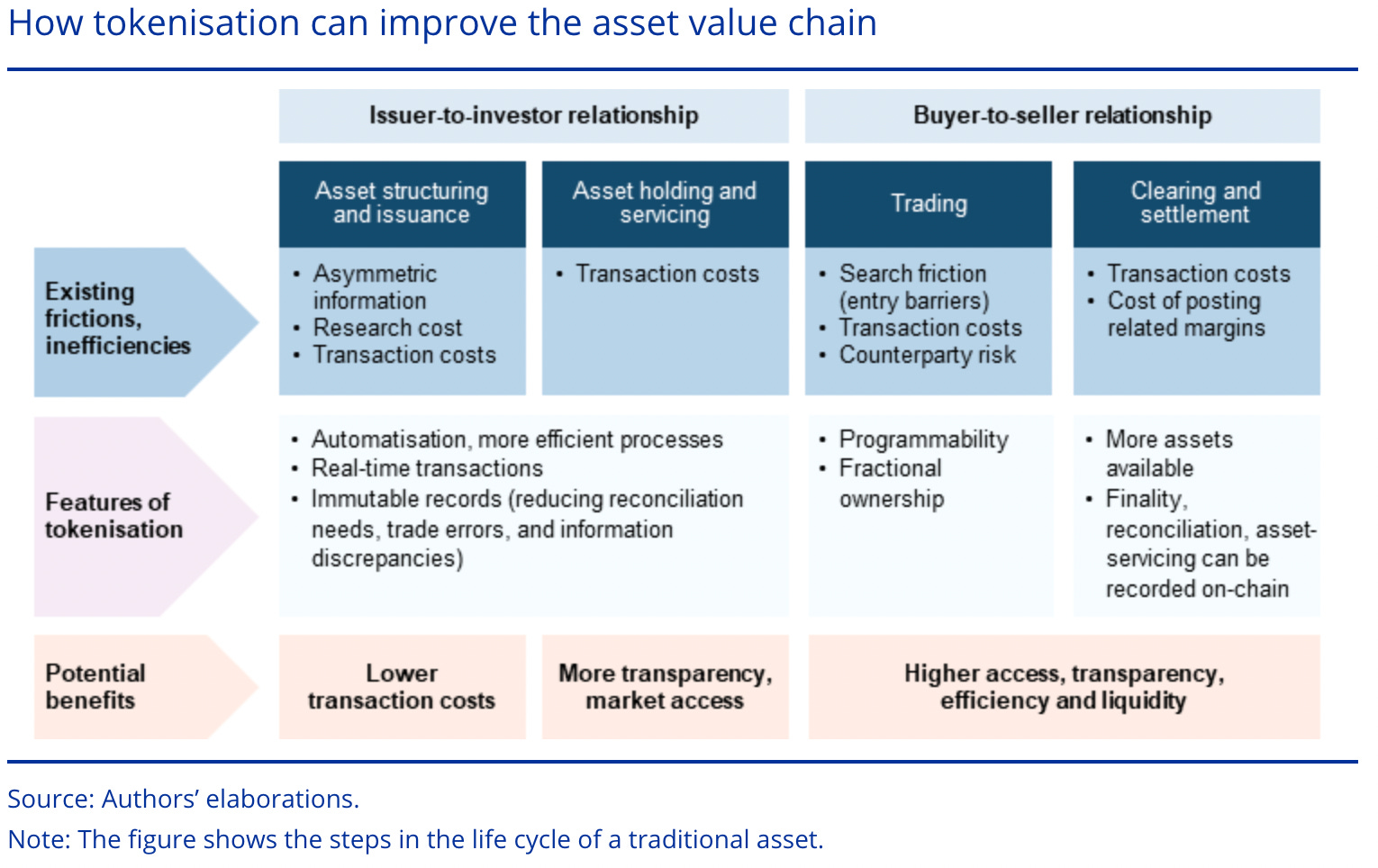
Why it matters: Europe just told the US model it's not welcome. In the US, tokenized deposits and private stablecoins are carrying the tokenization load. The ECB is saying: not here. The preferred rail is a wholesale digital euro or a DLT platform sitting on top of Eurosystem plumbing. Anything else is a second-class settlement asset in the world's second-largest capital market. Read together with MiCA, the message to USD stablecoin issuers is clearer than any regulation they’ve seen yet. You can operate in Europe. You just can’t win there.
ECB Macroprudential Bulletin 33, April 2026
Euro stablecoins and their potential effect on sovereign bond markets
Tokenised money market funds: new technology, familiar risks?
Tokenised bonds: assessing efficiency and liquidity in a nascent market
Other Signals
Infrastructure and Markets
Chainlink puts €2T of Swiss and Spanish equities data on-chain. SIX, the operator of the Swiss and Spanish exchanges, partnered with Chainlink to pipe its equities data directly onto blockchain networks. Link
Ether.fi launches crypto card on OP Mainnet, driving record $680M single-day TVL increase. Link
Tether invests in $134M round for Stablecoin Development Corp, a public stablecoin-infra vehicle. Link
Galaxy launches GalaxyOne for Business, integrated treasury platform for US entities. Link
DeFi and Blockchain
BNB Chain burns 1.57M BNB (~$1.02B) in the 35th quarterly auto-burn. Link
Legal & General Asset Management tokenizes £50B liquidity funds on Calastone’s network. Link
Ondo Finance files with the SEC for the tokenised S&P 500 tracking fund on Ethereum. Link
Keyrock issues tokenized corporate bond on Ethereum via Sygnum and Obligate. Link
Tron announces plan to upgrade network with post-quantum cryptography. Link
Regulation and Policy
SEC Division of Trading and Markets issued staff guidance providing a five-year no-action relief for certain self-custody crypto apps and DeFi interfaces from registering as broker-dealers. Link
UK FCA opens consultation on comprehensive crypto asset regime for 2027 rollout. Link
JPMorgan reports US CLARITY Act nearing final agreement. Link
White House study finds weak case for stablecoin yield ban. Link
Banking and Payments
Societe Generale-FORGE to integrate MiCA-compliant Euro stablecoin EURCV into MetaMask. Link
AllUnity launches MiCAR-compliant EURAU euro stablecoin on Stellar. Link
Rakuten integrates XRP into its payment network for 44M users in Japan. Link
Quantoz launches licensed Polish Złoty and British Pound stablecoins under MiCA. Link
PayPal integrates Brazil’s Pix instant payment system for small business checkout. Link
X product lead hints at crypto integration for upcoming “X Money” payments service. Link
Exchange, ETP and Market Structure
Bitwise launches spot Avalanche ETP (BAVA) with in-house staking for AVAX rewards. The ETP provides spot exposure to Avalanche (AVAX) and stakes the underlying assets through its in-house division to generate yield. Link
Goldman Sachs files with SEC for Bitcoin Premium Income ETF. Competes directly with BlackRock on yield-generating crypto products. Link
21Shares files amended S-1 for spot Hyperliquid ETF (THYP) on Nasdaq. Link
OKX launches regulated perpetual futures “X-Perps” in the EEA.
Leverages its Malta MiFID license to capture EU derivatives share pre-MiCA. Link
Our CEO Notes this week
If you're building infrastructure, allocating capital, or pricing the shift to always-on markets, this is the briefing your competitors already read on Monday.

That’s all for now, folks.
PRO Readers: Read our alpha insights below!
– Marc & Team


