



Hey, it’s Marc & the 51 team.
A sanctioned country just made Bitcoin a toll booth for 20% of the world’s oil.
Iran controls the Strait of Hormuz. About a fifth of global oil moves through it every day. After the 40-day war with the US and Israel ended in ceasefire on April 8, Iran started charging $1 per barrel in Bitcoin. Pay or you don’t pass. [NEWS]
Why Bitcoin? Iran can’t use dollars. Can’t use SWIFT. Can’t touch any payment rail the US controls. Bitcoin is the one network no country can freeze.
The math: roughly $20M a day in tolls. That’s 280 BTC daily, about 60% of all new Bitcoin mined. Bitcoin jumped from ~$68K to ~$72K on the news. But the price move is the least interesting part. A nation-state just made Bitcoin a prerequisite for accessing critical infrastructure. That’s new.
It was that kind of week.
Here’s what we’re covering:
The US just cracked open $7.7T in retirement savings to Bitcoin [Link]
Visa connected all agentic payment protocols to one rail [Link]
Morgan Stanley launched a spot BTC ETF that undercuts BlackRock by 44% [Link]
Three federal agencies published stablecoin rules in 48 hours [Link]
CME Group goes 24/7 for all crypto derivatives starting May 29 [Link]
And 20+ more signals. Let’s jump in 👇
Exclusive for 51 Readers:
👉 Register for Consensus Miami May 5-7, 2026, and get in the room where the people moving that money actually meet. Use this for up to $200 off:
🎟️ 20% Discount Code: MARC
🔗 Auto-applied discount link: https://go.coindesk.com/3NLCAAd
Top Boardroom Reads
The scalability trade-off is dead, with Bryan Pellegrino, CEO of LayerZero (51)
US Equities Tokenization: An Overview (Jane Street)
Effects of Stablecoin Yield Prohibition on Bank Lending (White House)
Prediction Markets: Addressing the Five Biggest Questions (Bitwise)
One Hundred Years in the U.S. Stock Markets (Research paper)
Digital Assets & Tokenized Finance Impact Report 2026 (FII Institute)
The Friday newsletter only scratches the surface. A lot more is going on that we’ll tell you in our PRO briefings.
Top Signals This Week
🚀 Build credibility. Drive pipeline. Win in digital assets. We produce institutional-grade research that positions you as the authority in your category, then distribute it to 100K+ decision-makers who act on what we publish.[let's talk →].

Visa connects all agentic payment protocols
On April 8, Visa announced Intelligent Commerce Connect, a single integration layer that lets merchants and AI agent builders accept payments from any of the competing agentic payment protocols. AWS, Aldar, Highnote, Mesh, and Payabli are already piloting it. [RELEASE]
Here’s the problem Visa is solving: AI agents are starting to buy things. They book flights, purchase software, reorder supplies. But every payment system speaks a different language. Right now, four major protocols are fighting to become the standard for how AI agents pay for things: Visa’s own TAP, Stripe’s MPP, OpenAI’s ACP, and Google’s UCP. Instead of trying to win that war, Visa said: we’ll support all of them.
Why it matters: Visa just did to agentic commerce what it did to e-commerce twenty years ago. It didn’t build the stores. It built the checkout counter that every store had to use. Visa’s bet is that it doesn’t need to win the protocol layer. It just needs to be the settlement layer underneath all of them. Most people will read this as an AI story. We think it’s a stablecoin adoption story wearing AI clothes.

🚨 Want more intelligence and understand what this means for your institution? Subscribe to PRO below:
Morgan Stanley launches spot BTC ETF
On April 8, Morgan Stanley launched its own spot Bitcoin ETF, ticker MSBT, and it did $34 million in first-day trading volume. Bloomberg’s Eric Balchunas called it a top 1% ETF launch and projects $5B in assets within a year. [RELEASE]
Zooming in: The fee is 0.14%. That’s the lowest in the market. BlackRock’s IBIT charges 0.25%. Grayscale’s mini trust charges 0.15%.
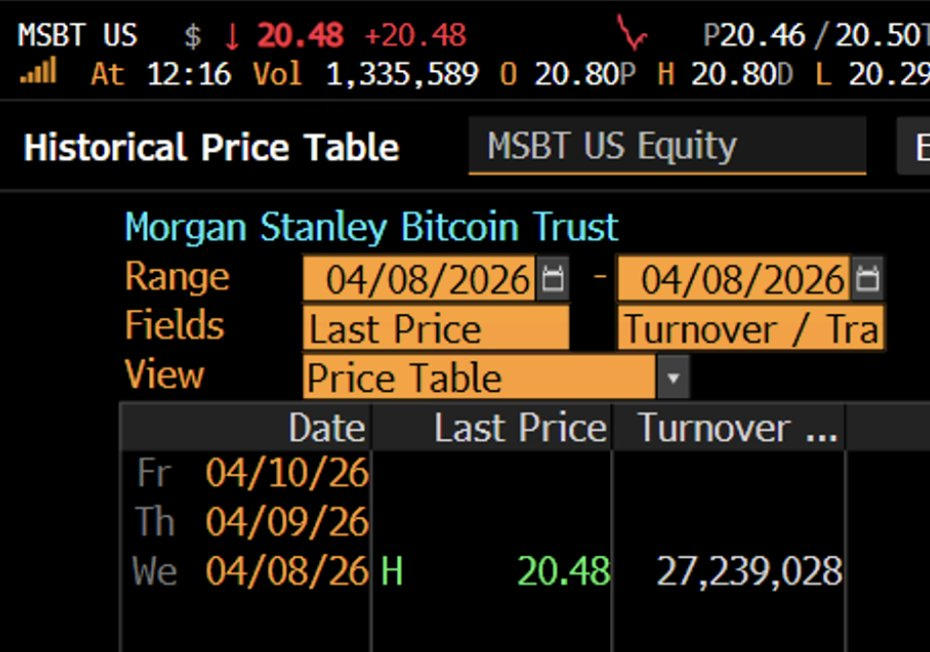
Why it matters: Morgan Stanley was already in the Bitcoin ETF business since August 2024, but as a distributor. Now they’re a manufacturer. The fee revenue stays in-house. They control the pricing, the positioning, the narrative. They have 16,000 financial advisors managing $9.3T in client assets. It won’t matter whose ETF is better. Morgan Stanley has an edge in selling.
Be smart: In January 2026, they filed S-1s for Bitcoin, Ethereum, and Solana ETFs. In February, they applied for an OCC National Trust Bank Charter, Morgan Stanley Digital Trust, to handle crypto custody, trading, swaps, and staking in-house. Later this year, they’re launching retail crypto trading on E*TRADE for Bitcoin, Ethereum, and Solana. Put it all together: a full-stack crypto wealth management platform inside a traditional bank. ETF products, proprietary custody, direct trading, staking yields, all under one roof. The Bitcoin ETF is the front door.

Get Morgan Stanley’s full digital asset playbook in the 51 Terminal 👇

U.S. just gave Stablecoins a banking rulebook
Last week we covered the Treasury’s 87-page GENIUS Act rule. This week, two more agencies piled on. Three federal agencies published stablecoin rules in 48 hours. That’s never happened in digital assets.
On Wednesday, FinCEN and OFAC proposed a rule spelling out exactly how stablecoin issuers must build anti-money laundering and sanctions compliance programs under the GENIUS Act. The rule formally classifies stablecoin issuers as “financial institutions” under the Bank Secrecy Act, the same bucket as banks and money transmitters. Treasury Secretary Bessent framed it as balancing protection with innovation. [NEWS]
What’s in it: Issuers must build and maintain full AML programs, file suspicious activity reports, and run sanctions compliance operations that meet OFAC standards. There’s even a provision barring anyone with a criminal background from heading a stablecoin issuer’s compliance program.
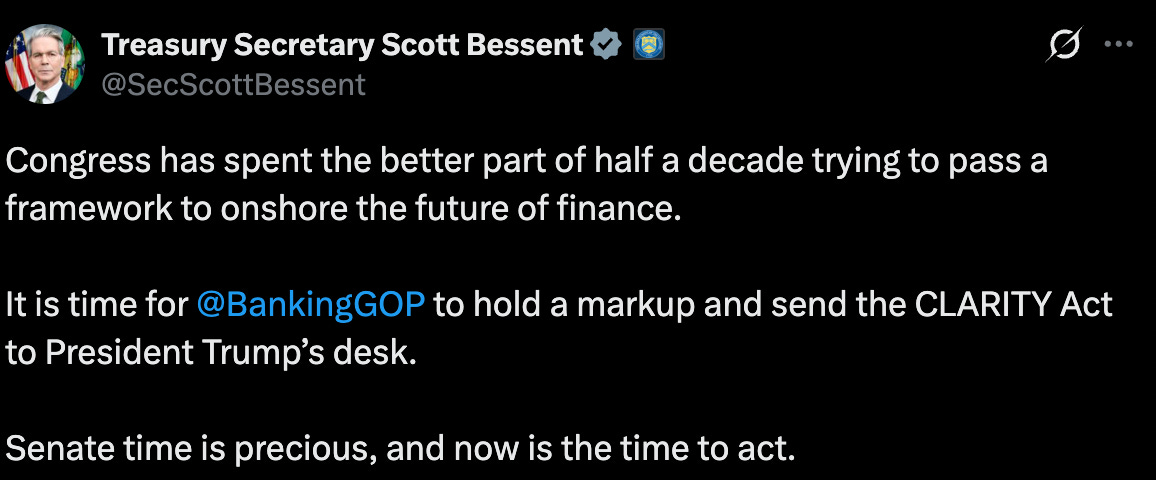
And Bessent publicly called on the Senate Banking Committee to mark up the CLARITY Act. Senate returns April 13. Markup is targeted for late April.
Why it matters: This is net bullish for the stablecoin ecosystem, even though it adds compliance costs. These rules remove the biggest barrier to institutional adoption: regulation. Banks, asset managers, and payment processors wouldn’t touch stablecoins at scale without clarity on the rules. Now they have it. The issuers who were already running serious compliance operations (Circle, Paxos) just got their moat widened. This also signals the passage of the Clarity Act very soon.
CME Group goes 24/7
On April 8, CME Group announced that starting May 29, all crypto futures and options will trade around the clock, seven days a week. [NEWS]
This is the world’s largest derivatives exchange. $1.4 quadrillion in notional value traded each year. Until now, crypto futures on CME followed traditional market hours with weekend gaps. That created an arbitrage window where offshore venues like Binance and Bybit captured weekend flow.
Why it matters: CME just removed the last timing advantage offshore venues had. Institutional traders can now hedge positions, manage risk, and adjust exposure without waiting for Monday morning. This compresses the gap between crypto-native infrastructure and traditional market plumbing. Expect volume to shift from offshore perps into regulated CME contracts, especially from hedge funds and macro desks that need clearing guarantees their compliance teams can sign off on.
Bitcoin in your 401(k)
The Department of Labor published a proposed rule that would let 401(k) plans include Bitcoin as an investment option. [Filing]
Quick distinction, because most headlines got this wrong. Trump’s executive order last August didn’t open 401(k)s to crypto. It told the DOL to start a rulemaking process.
Why it matters: 401(k) plans hold $7.7 trillion and cover roughly 90 million Americans. Unlike spot ETF flows, which are discretionary, 401(k) contributions are automatic, recurring, and dollar-cost-averaged through payroll. Average holding period is decades. If even 1% flows into Bitcoin, that's $77 billion. More than all spot Bitcoin ETF inflows in their first year combined. Comment period closes June 1. Final rule expected Q4 2026. First plans could offer Bitcoin ETFs by early 2027.
Other Signals
Infrastructure and Markets
Broadridge’s DLT repo platform processed $8 trillion in March 2026. That’s 392% growth year over year. Repo is the plumbing of capital markets, $4T+ traded daily. Broadridge just proved DLT works at that scale. [RELEASE]
Circle launched cirBTC. A wrapped Bitcoin product designed to challenge WBTC. Circle is betting its institutional reputation that the market wants a trust-minimized, audited alternative. [NEWS]
Securitize hired Brett Redfearn as President. He ran the SEC’s Division of Trading and Markets. [NEWS]
Pyth Network data marketplace launches with Fidelity and Euronext. On-chain price feeds backed by TradFi institutions. [NEWS]
Tether testing investor appetite at $500B valuation. If they raise at that number, Tether would be one of the 20 most valuable private companies on earth. [NEWS]
Regulation and Policy
SEC safe harbor proposal sent to the White House for interagency review. $75M cap, 4-year exemption for token projects. If finalized, this gives crypto startups a legal path to launch without immediate securities registration. [Filing]
CFTC sued multiple states over prediction market jurisdiction. This ties directly to the Hougan quote at the top. Prediction markets are becoming a real asset class, and the turf war between federal and state regulators just went public. [NEWS]
Hester Peirce publicly apologized for the SEC’s past regulatory approach. A sitting SEC Commissioner said the agency got it wrong. That doesn’t happen often. [NEWS]
Todd Blanche named interim Attorney General. The DOJ’s approach to crypto enforcement is shifting. [NEWS]
EU considering centralizing all crypto supervision under ESMA. One regulator for all 27 member states. If adopted, this would be the most significant structural change to MiCA since it was enacted. [NEWS]
Banking and Payments
Schwab confirmed spot Bitcoin and Ether trading launching H1 2026. 35 million brokerage clients about to get direct access. [NEWS]
Standard Chartered exploring full takeover of Zodia Custody. A top-20 global bank potentially going all-in on digital asset custody. [NEWS]
Paysafe and MoonPay partnered for crypto payments. Paysafe processes $167B annually. [NEWS]
Swiss banks launched a CHF stablecoin sandbox. Seven banks including UBS. A consortium approach to national stablecoin issuance. [NEWS]
Circle’s CPN Managed Payments went live. [RELEASE]
Coinbase’s OCC trust charter received conditional approval. The largest US crypto exchange is becoming a nationally chartered trust bank. [NEWS]
Digital Assets and DeFi
Ethereum Foundation completed its 70,000 ETH staking target. $93M staked. The Foundation is eating its own cooking. [NEWS]
Ant Group / Anvita building AI agents on crypto payment rails. [NEWS]
IMF warned that tokenization could amplify financial stability risks. Worth reading for the counterargument. [Report]
Bitcoin quantum-resistant wallet prototype announced. [NEWS]
Solana launched STRIDE framework after the $285M Drift hack. [NEWS]
US Treasury launched cybersecurity threat-sharing for crypto firms. [NEWS]
Morgan Stanley plans a private credit fund. [Link]
Our CEO Notes this week
If you're building infrastructure, allocating capital, or pricing the shift to always-on markets, this is the briefing your competitors already read on Monday.

That’s all for now, folks.
PRO Readers: Read our alpha insights below!
– Marc & Team


