



Hey, it’s Marc & the 51 team
Nothing prepares you for a month where the Fed buys its own debt, the US military is running a Bitcoin node, and the Treasury Secretary Scott Bessent calls crypto "very important payment rails” for the country.
The Senate Banking Committee was supposed to mark up crypto legislation this month, but the date was delayed until May.
“If we don’t get the Clarity Act passed by May, digital asset legislation will not pass for the foreseeable future.”
— United States Senator Bernie Moreno
On top of that, we saw one of the biggest blow-ups in DeFi. We’ve watched a lot of them, but this one’s different.
These are our highlights this week:
Why Treasury’s record buyback matters to USDT
Congress just rewrote Fed access rules
The $196M hole Aave didn’t code
Singapore just flanked PAXG with a bank
DTCC front-runs Crypto to own tokenized Wall Street
Japan’s banks ditch Euroclear for Canton JGB repo
And 15+ more signals. Let’s jump in 👇
Exclusive for 51 Readers:
👉 Register for Consensus Miami, May 5-7, 2026, and get in the room where the people moving that money actually meet. Use this for up to $200 off:
🎟️ 20% Discount Code: MARC
🔗 Auto-applied discount link: https://go.coindesk.com/3NLCAAd
Top Boardroom Reads
How the U.S. Weaponized the Dollar (And Stablecoins), with Eddie Fishman, New York Times Bestseller (51)
2026 Institutional Investor Survey on Digital Asset Investment Trends (Nomura)
How tokenised assets transform liquidity management (Deutsche Bank)
CLARITY Act Update: Final Push Ahead (Galaxy)
Tokenized collateral goes global (ValueExchange)
Adopting AI Agents in Banking (Creatio)
The Friday newsletter only scratches the surface. A lot more is going on that we’ll tell you in our PRO briefings.
Top Signals This Week
Why Treasury’s record buyback matters to USDT
On April 16, 2026, the U.S. Treasury executed a record $15 billion debt buyback, matching the largest single-day operation in the program’s history. The operation targeted off-the-run nominal coupon securities maturing between May 2026 and April 2028, with settlement on April 17. The Treasury funded the repurchase through new bill issuance, keeping overall debt stock largely unchanged, but shifting the duration profile toward the short end of the curve. [NEWS]
Why it matters: Tether’s $141.6B in Treasury exposure as of Q4 2025 makes it the 18th-largest holder of U.S. government debt on the planet. The company printed more than $10 billion in net profit in 2025 almost entirely on T-bill yield. A buyback that absorbs off-the-run coupons and recycles them into bill issuance is, mechanically, a subsidy to Tether’s business model: it deepens the market for the exact instrument USDT requires as collateral and keeps front-end yields structurally attractive. Whether the Treasury intends this or not, the effect is symmetric with supporting the peg.
Be smart: Recent BIS research found stablecoin inflows reduce three-month T-bill yields by 2–2.5 bps within 10 days; outflows widen them by 6–8 bps. The buyback is now part of that same feedback loop, on the supply side.
🚀 Build credibility. Drive pipeline. Win in digital assets. We produce institutional-grade research that positions you as the authority in your category, then distribute it to 100K+ decision-makers who act on what we publish.[let's talk →].

Congress just rewrote Fed access rules
On April 21, Reps. Kim and Liccardo introduced the PACE Act to establish a federal registration regime for non-bank payment firms, overseen by the OCC. Qualifying firms must hold a state bank or credit union charter, or 40 or more active state money transmitter licenses. Registered firms gain direct access to Fedwire, FedNow, and FedACH, rails historically walled off to chartered banks. [RELEASE] [PDF]
Why it matters: Getting a federal crypto license is nearly impossible for newcomers, and that’s by design. To qualify, a company needs money-transmission licenses in at least 40 states. Only a handful of giant, established companies have bothered to collect that many, think PayPal, Circle, Coinbase, and Western Union. They spent years and millions of dollars building up those licenses. Kraken already got approved through a different route (the Federal Reserve), so this rule doesn’t even affect them. Everyone else, any startup or smaller company trying to enter the market, is simply locked out. They haven’t had the time or money to get 40 state licenses yet.
The $196M hole Aave didn’t code
Nobody hacked Aave last weekend. $196M walked out the door anyway. The attacker forged a message on a bridge next door, minted $292M of fake rsETH, and posted it to Aave as collateral. That’s the problem. [ANNOUNCEMENT]
Why it matters: DeFi lending is not a product. It’s an unpriced insurance contract on every asset listed. Aave’s defense is that its contracts worked. That is true. It is also beside the point. A depositor who supplies WETH to Aave is not just lending to Aave. They are lending into every cross-chain bridge that underpins every collateral asset Aave accepts. LayerZero broke. Kelp’s bridge released unbacked tokens. Aave’s oracle priced those tokens as real. The loss landed on WETH suppliers. The smart contract did its job. The insurance contract was never written, and not a single audit scope covered such incidents.
PRO Analysis:

Singapore just flanked PAXG with a bank
On April 21, 2026, OCBC ($526B in total assets), its asset-management arm Lion Global Investors, and MAS-regulated digital-asset exchange DigiFT launched GOLDX, a security token that provides on-chain exposure to the LionGlobal Singapore Physical Gold Fund ($525.9M in AUM). Tokens are issued natively on Ethereum and Solana. [RELEASE]
Why it matters: The tokenized commodities are a $6.1B market, 97% controlled by Paxos Gold (PAXG) and Tether Gold (XAUT). Both are crypto-native issuers with vault partnerships but no institutional deposit relationships, no MAS license, no fund-structured wrapper. OCBC’s entry is the first time a G-SIB has issued a physically-backed tokenized gold product on public chains, and it is wrapped as a regulated collective investment scheme, not a bare commodity token. Asset managers who were blocked from holding PAXG on regulatory or mandate grounds now have a bank-issued alternative that clears the compliance hurdle in one move. The $6B tokenized-gold segment just acquired an institutional tier.
Be smart: MAS runs a wholesale CBDC pilot on the Singapore dollar. And now OCBC has issued the first physically-backed bank-grade tokenized gold fund. Four moves, including commodities, gold, credit, and CBDC, all within one regulator’s jurisdiction.
DigiFT obtained CMS + RMO licenses in December 2023.
Standard Chartered-backed Libeara launched the MG 999 synthetic gold fund.
Tokenized commodities and credit, under Project Guardian with 40+ financial institutions.
🚨 Want more intelligence and understand what this means for your institution? Subscribe to PRO below:
DTCC front-runs Crypto to own tokenized Wall Street
On April 13, DTCC published its public-facing roadmap. The pilot launches in H2 2026.
Be smart: DTCC has been quietly assembling the pieces for two years. It started with a December 2025 SEC no-action letter granting DTC a three-year exemption from Reg SCI, Section 19(b) rule-filing requirements, and key clearing standards under Rules 17Ad-22 and 17Ad-25. That cleared the regulatory path. [RELEASE]
In March 2026, the House Financial Services Committee held its hearing on tokenized securities, and DTCC Deputy General Counsel Christian Sabella filed written testimony the same day.
Why it matters: The testimony’s most important word was not “tokenization,”it was “interoperability.” Sabella made a specific argument: tokenization efforts built in “isolated or proprietary environments risk fragmenting liquidity and increasing cost.” DTCC is warning against a world where every bank, exchange, and fintech builds its own tokenization silo. The alternative DTCC is proposing is itself an open, protocol-agnostic infrastructure layer where tokenized securities inherit the legal protections, netting benefits, and settlement guarantees that exist today and hence acts as the connective tissue between every tokenization effort on Wall Street.
PRO Analysis:

Japan’s banks ditch Euroclear for Canton JGB repo
On 20 April 2026, Japan Exchange Group announced that JSCC, Mizuho Financial Group, Nomura Holdings, and Digital Asset Holdings had begun a proof-of-concept to use JGBs as digital collateral on the Canton Network. The trial runs through late September 2026 and is one of three initiatives the Japanese Financial Services Agency (JFSA) formally selected in February 2026 for its Payment Innovation Project, the FSA’s successor to the FinTech PoC Hub. [RELEASE]
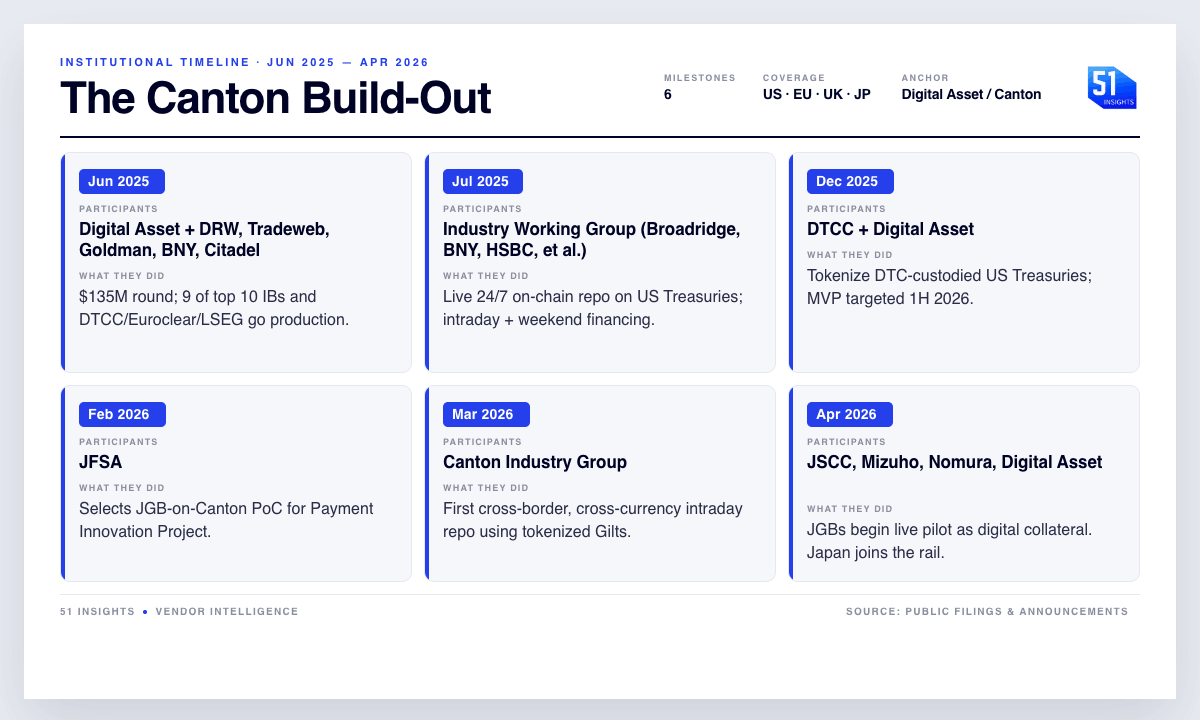
Why it matters: Unlike the US (Fed, BNY, JPM) or Europe (Euroclear, Clearstream), Japan has no domestic tri-party repo venue. JGB holders who want to finance their bonds must either use bilateral gensaki with manual margin workflows or ship their JGBs to Euroclear’s Collateral Highway and finance offshore. The Canton pilot is the first serious attempt to build that plumbing natively, and it skips the 15-year build by using an L1 that is already live with DTCC and Euroclear. If JSCC goes from PoC to production, Japanese banks suddenly recapture collateral velocity that currently leaks to London.
Other Signals
Infrastructure and Markets
Coinbase introduced the app store for agents, Agentic.Market. Link
Kalshi is launching crypto perpetual futures on April 27. The CFTC-regulated prediction market, most recently valued at $22B, brings non-expiring crypto contracts to US retail for the first time. Link
Polymarket announced plans to launch perpetual futures with up to 10x leverage on BTC, gold, Nvidia, and other assets. Link
Core Scientific priced $3.3B in senior secured notes due 2031 at a 7.75% coupon. Proceeds fund data centre expansion across Georgia, Texas, North Carolina, and Oklahoma as the miner pivots deeper into AI hosting. Link
$350M in crypto shorts liquidated in 24 hours as Bitcoin rallied from $74K to $78K. A classic short squeeze, triggered as US-Iran tensions cooled and traders moved back into risk assets. Link
DeFi and Blockchain
North Korea’s Lazarus Group deployed “Mach-O Man,” a new macOS malware campaign targeting crypto and fintech executives. Link
Tether froze $344M in USDT across two Tron addresses in coordination with OFAC and US law enforcement. Link
Tether minted $1B USDT on Ethereum. Link
Regulation and Policy
Japan’s Cabinet approved reclassifying 105 cryptoassets, including BTC and ETH, as financial instruments under the FIEA. Same legal status as stocks and bonds, insider trading rules now apply, and a 20% flat capital gains tax is on the table. Link
The Swiss Federal Council published its final Capital Adequacy Ordinance (CAO) on April 22, 2026. The ordinance specifies the regulatory capital treatment for select, undisclosed assets for banks headquartered in Switzerland. Link
Belarus legalized crypto banks handling 26 cryptocurrencies including Bitcoin, Ethereum, Solana, and Toncoin. Licenses cover 11 services: deposits, loans, staking, transfers, token issuance, and exchange. Link
US Admiral Samuel Paparo confirmed INDOPACOM is running a live Bitcoin node for operational security tests. First time a US military combatant command has publicly acknowledged direct participation in the Bitcoin network. Link
A White House official publicly condemned the banking sector’s lobbying against a compromise on yield-bearing stablecoins within the proposed CLARITY Act. Link
Banking and Payments
Coinbase listed tGBP, the first UK-regulated pound-pegged stablecoin, on its global platform. Issued by BCP Technologies under the FCA’s sandbox framework, giving British users on-chain GBP without FX conversion costs. Link
Singapore Gulf Bank (SGB), a licensed digital bank in Bahrain, has launched a stablecoin minting and redemption service for corporate and high-net-worth clients. Link
Funds, Deals and others
Payward (Kraken) has agreed to acquire the U.S.-based digital asset derivatives platform Bitnomial. The transaction is valued at up to $550M in a combination of cash and stock. Link
Michael Saylor’s Strategy has bought another $2.54B in Bitcoin. Link
Our CEO Notes this week
If you're building infrastructure, allocating capital, or pricing the shift to always-on markets, this is the briefing your competitors already read on Monday.
That’s all for now, folks.
PRO Readers: Read our alpha insights below!
– Marc & Team


