



Hi, it’s Marc. ✌️
“Any asset that has annualized volatility four times greater than the stock market is not a safe haven asset. So we’re done right there.”
I just spent an hour with Cam Harvey. Economist and Duke finance professor. He advises Man Group with $325B in AUM. His 1986 yield curve model has called every US recession since. Five for five. We sat down to unpack why his recession model gave a “false signal” in 2023, why AI agents are the secret growth engine for stablecoins, and why we are currently living through the most disruptive decade in human history. In this conversation, he prices Bitcoin’s digital-gold thesis, the agent-to-agent economy, the yield curve’s eight-of-nine recession record, and the four simultaneous technology disruptions he says CFOs are dangerously underestimating.
Back in 1986, as a University of Chicago PhD student, he introduced a model that used the shape of the yield curve to predict recessions. It was heavily scrutinized at the time. Today, it boasts an 8-for-9 track record. [Read Thesis]
“Bitcoin is not a substitute for gold. It might be a complement, but it is not a substitute.”
That is a provocative stance from a man who literally wrote the book on DeFi and the Future of Finance. But Cam’s perspective isn't anti-crypto; it's hyper-rational.
“Just gambling on crypto, that’s not solving any problem. What I’m interested in is doing stuff that increases both economic growth and economic well-being. And something like a stablecoin is fully equipped to do that.”
Cam believes that DeFi will disrupt the traditional financial system by removing costly middlemen, increasing financial inclusion, and driving mass tokenization. And, this will happen as DeFi will eliminate centralized institutions like commercial banks, stock exchanges, and brokerages.
About Campwell: Cam Harvey is Professor of Finance at Duke University’s Fuqua School of Business, a Research Associate at the National Bureau of Economic Research, and a past President of the American Finance Association. He is also Partner and Senior Advisor at Research Affiliates ($150B+ AUM) and an investment strategy advisor at Man Group, the world’s largest publicly listed hedge fund. He co-founded the Duke-Fed CFO Survey in 1997, still the most cited corporate sentiment study in the US, and authored “DeFi and the Future of Finance.” His Coursera specialization on decentralized finance has trained more than 102,000 students. His September 2025 paper “Gold and Bitcoin” is driving the institutional conversation about Bitcoin’s real risk profile in 2026.
🚨We’re opening sponsorships for our next podcast series. Top guests. Serious listeners. Claim your spot →
🎧 Jump to the best parts
00:00 Cam Harvey Introduction
02:09 The Aave Exploit Explained
07:53 Why DeFi Still Matters
12:30 What Happened With Aave and Kelp
15:34 The Origin of the Yield Curve Model
22:35 Why the 2022 Recession Never Happened
30:20 Why Cam Entered Crypto and DeFi
43:19 Why DeFi Solves Real Problems
51:55 Bitcoin vs Gold
57:18 Can Bitcoin Be Attacked
01:00:56 The Duke Fed CFO Survey
01:03:25 Stablecoins vs Banks
01:07:13 Why CEOs Underestimate AI
01:09:42 The Four Technological Disruptions
01:15:18 AI and the Future of Education
Important Links
LinkedIn: https://www.linkedin.com/in/camharvey
Duke University’s Fuqua School of Business: https://www.fuqua.duke.edu/faculty/campbell-harvey
Google Scholar: https://scholar.google.com/citations?user=cajqjGAAAAAJ&hl=en
Gold and Bitcoin: https://papers.ssrn.com/sol3/papers.cfm?abstract_id=5530719
Tokenised Gold: https://papers.ssrn.com/sol3/papers.cfm?abstract_id=5995434
Watch or listen now:
YouTube • Apple Podcasts
🚀 Build credibility. Drive pipeline. Win in digital assets. We produce institutional-grade research that positions you as the authority in your category, then distribute it to 100,000+ decision-makers who act on what we publish. Let’s talk.

Our biggest takeaways from this conversation:
1. The yield curve model worked because everything else was wrong
When Harvey presented his recession-prediction model in 1986, the criticism was simple: not enough data. Four recessions, four correct calls. Now it's five for five.
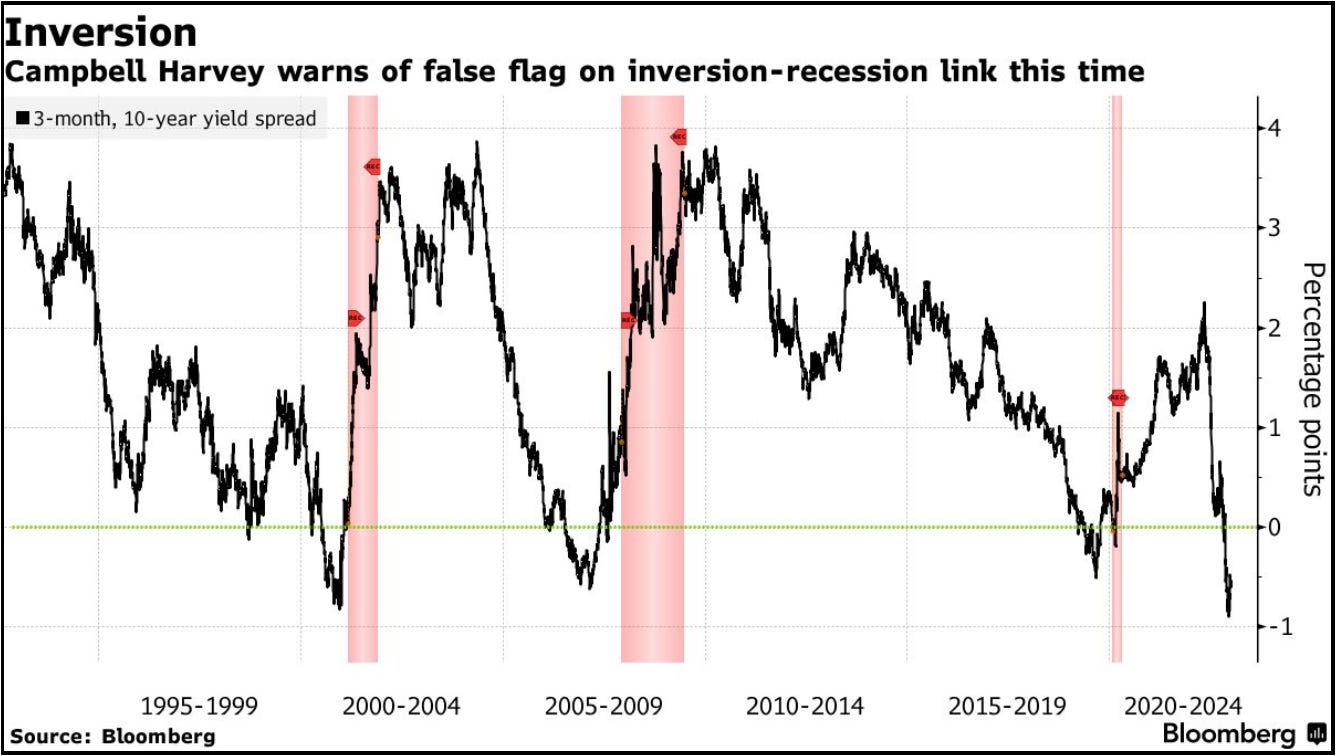
The mechanism is elegant, the spread between a 10-year Treasury and a 3-month T-bill encodes forward-looking expectations about growth in a way that stock prices, with their volatility and absent maturities, never could.
“A model is a simplification of reality. It looks at one thing, the difference between the yield on the 10-year and the yield on the Treasury bill. That’s it, one variable.”
The 2022 inversion looked like a sixth hit coming. It wasn’t. Harvey went on record in real time calling it a false signal, and laid out five reasons: the model’s own publicity had changed CEO and CFO behavior, companies undertook prophylactic layoffs and slashed investment even without an actual downturn, and COVID-era stimulus artificially propped up consumption. The recession was partly managed away because enough people believed the model.
“You might even think that that inversion in 2022 sufficiently changed behavior so that we dodged a potential recession.”
This is a great example to assess how outcome changes when the signal is widely known. Market is very dynamic and the signal that work eventually change the behavior they were measuring.
2. The Kelp DAO exploit will trigger regulatory extinct
The Aave incident that preceded this conversation, in which attackers drained $292 million from a smaller protocol, KelpDAO, used the stolen tokens as collateral on Aave to borrow ETH, and left Aave holding bad debt, got significant press. Harvey’s response was careful to avoid both dismissiveness and alarm.
“The protocol operated exactly as it should have operated. Don’t interpret this as ‘we’ve seen this before, it’s no big deal.’ It is a big deal. It does point to improvement that’s necessary.”
The regulatory problem is genuinely hard. am has a paper forthcoming in Research Policy on how to regulate decentralized protocols, and his point of view should worry anyone who thinks “ban it” is a viable response.
His partial solution is indirect: regulated entities like Coinbase, if they choose to interact with a decentralized protocol, have legal liability exposure that gives them an incentive to pressure protocols toward better security.
He also makes a point that frequently gets dropped in these conversations: 80% of the value of all U.S. paper currency is held in $100 bills. Almost no one uses them for legitimate transactions.
Related reads:

3. Bitcoin is not digital gold, and calling it that is the wrong sale
Harvey has published research on both Bitcoin and gold, and his conclusion is direct: they are not substitutes. The “digital gold” framing, he argues, is a marketing pitch that doesn’t survive contact with the data.
“Any asset that has got annualized volatility that is four times greater than the stock market is not a safe haven asset. So we’re done right there.”
The case against Bitcoin-as-gold runs on three tracks.
Volatility: drawdowns approaching 70% are not consistent with a store-of-value thesis.
Tangibility: gold has industrial, technological, and artistic applications that put a floor under its price. Bitcoin does not.
The 51% attack vector.
Harvey sketches a credible scenario in which a well-capitalized actor takes a large short position in Bitcoin derivatives, then spends what he estimates is a feasible sum to acquire 51% of network hash power, driving the price toward zero as they profit on the short. For gold, no equivalent attack exists.
On quantum computing, the other threat frequently cited, he is notably less alarmed. The technology to build quantum-proof wallets already exists.
“The quantum attack I’m not as worried about, other than if these old public keys are harvested, there’s going to be a big sale of Bitcoin that could drive the price down somewhat.”
Bitcoin may still be valuable. Harvey does not dismiss it. But it is a complement to gold, not a replacement, and conflating the two misleads both asset classes.
Related podcast and reads:


