




Hey, it’s Marc.
Big week for crypto regulation: The industry just shot itself in the foot.
“We’d rather have no bill than a bad bill.”
— Brian Armstrong, CEO and Co-founder of Coinbase
Twenty-four hours before Congress was set to vote on the most comprehensive crypto bill in U.S. history, Coinbase pulled its support. His stance: the CLARITY Act would ban stablecoin yield, narrow tokenized asset pathways, and expand surveillance in DeFi. Plus: Coinbase would lose around $1.4B in annual revenue.
Now, the Senate Banking Committee has postponed the markup meeting, which was scheduled on January 15, 2206 - and billions of dollars in investment, and years of bipartisan work could evaporate. Policy chaos.
Our highlights this week:
CLARITY Act collapse reveals deep fractures in U.S. crypto coalition
Polygon pivots to payments with $250M acquisition
BNY Mellon launched tokenised deposits
Bitmine invests $200M in MrBeast
Swift proves tokenised bonds work on existing rails
Let’s jump in 👇
Top Boardroom Reads
Why Polygon chose payments, with Marc Boiron, CEO of Polygon Labs (51)
Why Bitcoin’s biggest risk isn’t regulation, with Garrick Hileman (51)
Myth vs. Fact: The CLARITY Act (US Senate Committee)
Beyond Stablecoins: The Rise of the Internet Financial System (Circle)
Do We Have Enough Power? (Galaxy Digital)
Cryptocurrency’s Transition to a Sovereign Financial Infrastructure 2025-2030 (Study)
Global M&A Outlook 2026 (JPMorgan)
VanEck Q1 2026 Outlook: Risk On (VanEck)
How Stablecoins Can Improve Payments and Global Finance (IMF)
Top Signals This Week
The CLARITY Act collapse
What happened: The U.S. Senate Banking Committee's CLARITY Act, designed as a comprehensive crypto regulatory framework, collapsed on January 14, 2026, when Coinbase CEO Brian Armstrong withdrew support less than 24 hours before the markup. The bill's "Market structure draft," released January 12, included three provisions that triggered industry revolt: a ban on stablecoin yield payments (worth ~$1.4B in annual Coinbase revenue), mandatory SEC clearing for tokenised equities, and extended Bank Secrecy Act compliance to open-source developers. Chairman Tim Scott cancelled the vote.
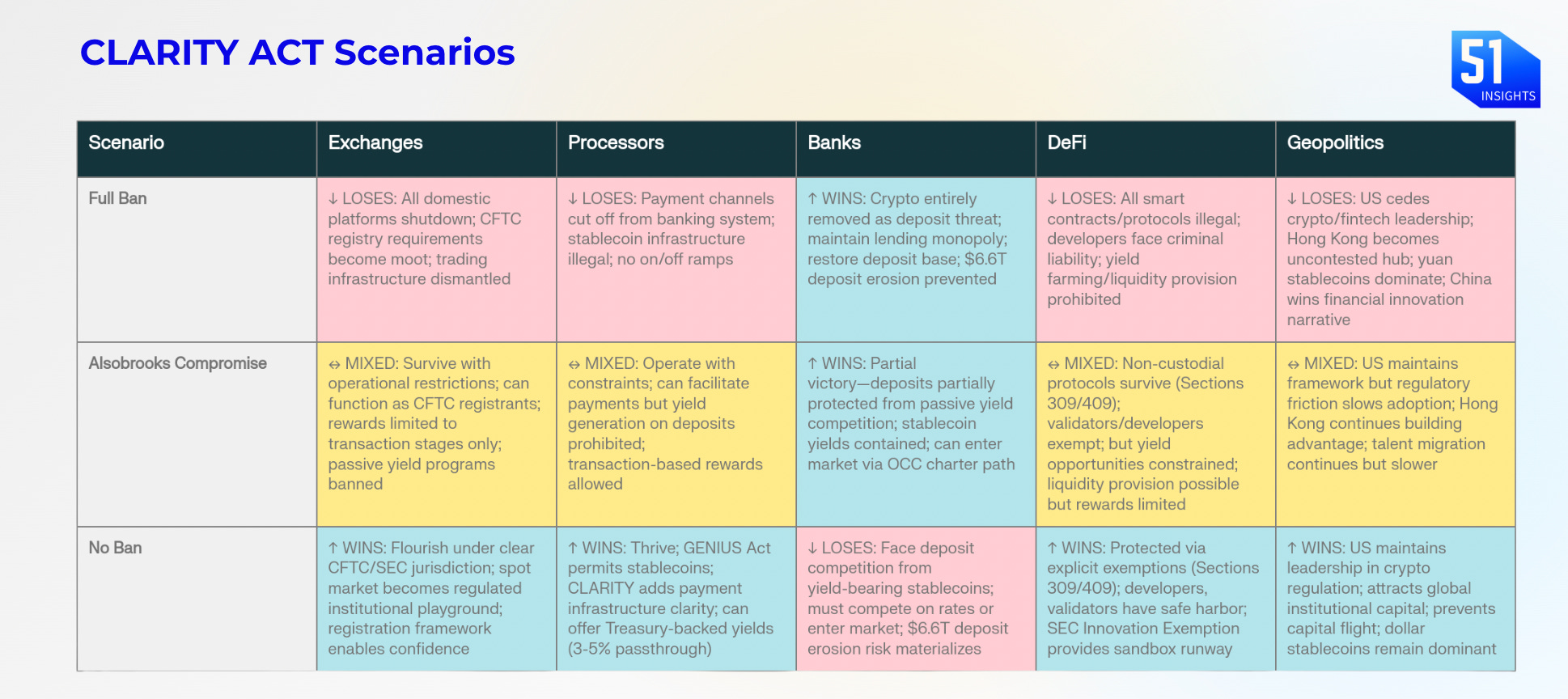
Why it matters: The legislative failure exposes a growing divide between crypto operators and venture capital interests. While firms like a16z supported the bill to achieve asset liquidity and commodity status for tokens, Coinbase prioritised protecting its high-margin stablecoin business. Furthermore, it also highlights the ABA’s successful lobbying to protect traditional deposit bases, despite a more pro-crypto Senate leadership.
So what? China weaponised yield on January 1st. The People’s Bank of China announced that commercial banks can pay interest on e-CNY wallets, transforming the digital yuan into a direct “yield-bearing” competitor to the USD in international stablecoin settlemet.
What's next: The legislative window is closing fast. Senate insiders expect revised drafts in February, but passage before the November 2026 midterms is increasingly unlikely, pushing comprehensive federal crypto regulation into 2027 at the earliest.
Read more below.👇

Polygon pivots to payments with $250M acquisition
Polygon Labs announced on January 13, 2026, that it will acquire Coinme and Sequence in deals totaling over $250M, positioning itself as a regulated U.S. payments provider. [RELEASE]
The deal bundles to form the “Open Money Stack”:
Coinme’s licensed fiat on-/off-ramps and retail touchpoints (48 state Money Transmitter Licenses)
Sequence’s wallet abstraction and cross-chain orchestration
AggLayer liquidity (a ZK-powered settlement engine)
So what? Polygon is undergoing a radical “narrowing.” By moving away from being a general-purpose “World Computer” and focusing on being the “Global Payments Layer,” they are positioning themselves to capture a good share of the $300B+ stablecoin market.
More below.


BNY Mellon launched tokenised deposit
What happened: BNY launched tokenised deposits on the Canton Network, a privacy-enabled interoperability protocol designed by Digital Asset. Clients (Citadel Securities, Intercontinental Exchange, Circle) can now move commercial bank money across blockchains 24/7 with atomic settlement and zero counterparty risk. A $100M deposit becomes $100M in tokens. Transfers are instant. Redemption is instant. No T+2 settlement window. No trapped capital over weekends. [RELEASE]
So what? Citi projects tokenized deposits could handle $100–140T in annual transaction flow by 2030. Stablecoins, the public alternative, are projected at $95–200T in velocity, but that's misleading. A dollar in a stablecoin circulates faster than a dollar in a tokenized deposit because it's used for retail payments and DeFi. But for the $2.5 quadrillion derivatives market, for margin optimization, for collateral management, where trillions of dollars sit idle every weekend, tokenized deposits win on utility.
🚨 We just opened new sponsorship slots for our newsletters & podcast. Want to reach 35k+ digital asset leaders? Contact us here.
Bitmine invests $200M in MrBeast
What happened: Bitmine Immersion Technologies, the largest corporate holder of ether (valued at $13.6B), is investing $200M in Beast Industries, the company behind YouTube creator MrBeast. The deal closes by January 19 and gives Bitmine equity in a platform commanding 450M+ YouTube subscribers. Beast Industries plans to launch a decentralized finance–enabled financial services platform, building on earlier trademark filings for "MrBeast Financial." [RELEASE]
Why it matters: By targeting Gen Z and Gen Alpha, demographics increasingly resistant to legacy banking, the initiative seeks to normalise blockchain-based financial products through creator-led trust. For Bitmine, which holds 3.36% of the circulating Ether supply, the move creates a direct pipeline to onboard millions of new users into the Ethereum ecosystem, effectively turning its reserves into productive consumer capital.
Our view: With DATs1 losing momentum, this looks like a bottom-up approach by Bitmine to manufacture organic utility for its $13.6B Ether position, pivoting from a reliance on institutional catalysts to a strategy of aggressive retail onboarding through creator-led trust.
Swift proves tokenised bonds work on existing rails
What happened: Swift, in collaboration with partners including BNP Paribas, Société Générale – FORGE, and Intesa Sanpaolo, has completed a series of trials for orchestrating tokenised bond transactions and cross-border payments. The initiative demonstrated seamless delivery-versus-payment2 (DvP) settlement and lifecycle management across multiple blockchains and traditional systems. Consequently, Swift is now integrating a blockchain-based shared ledger into its infrastructure to enable real-time, 24/7 global transaction execution. [RELEASE]
Why it matters: Crypto startups bet on replacing SWIFT's network. SWIFT just proved it can layer blockchain settlement UNDER the existing network. Every bank already trusts SWIFT. Nobody needs to migrate. The 200+ billion daily messages keep flowing through SWIFT - just with better back-end plumbing.
🙌 Work with us: We arm financial institutions and digital asset leaders with bespoke research, thought leadership to shape the most important conversations, scale trust, and win business.

News Flash
Dubai moves to ban privacy coins. Link
Wells Fargo allows BTC as collateral for loans. Link
Venezuela used USDT to bypass sanctions. Link
Ripple secures FCA authorisation in the UK. Link
BitPanda eyes Frankfurt IPO in 1H26. Link
StanChart plans crypto prime brokerage. Link
Interactive Brokers adds 24/7 USDC funding. Link
Anchorage enables off-chain collateral for lending. Link
Visa Direct will use BVNK’s infrastructure. Link
DFSA shifts crypto token oversight to firms. Link
80% of Venezuela’s oil revenue is collected in stablecoins. Link
That’s all for now, folks.
PRO Readers: Read our alpha insights below!
– Marc & Team


