




Hey, it’s Marc.
For a decade, the “safe” career move for wealth managers was to mock Bitcoin. As of this week, that stance is officially a liability.
Two massive dominos – managing a combined $13 trillion – just fell.
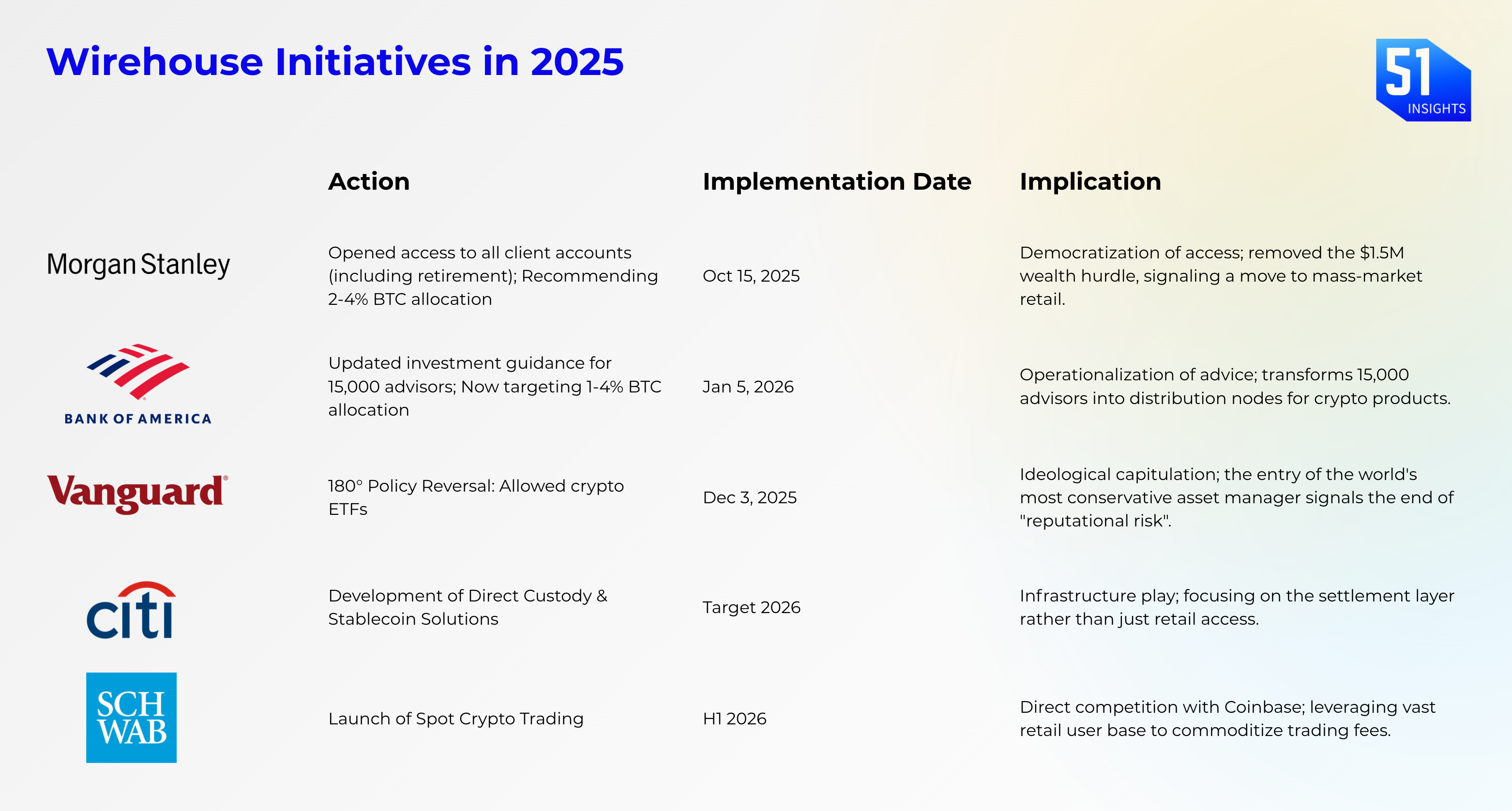
First, Bank of America, starting Jan 5, 2026, are actively prescribing Bitcoin to their wealth management clients. Second, Vanguard, the final boss of anti-crypto sentiment, just unlocked the gates for 50 million investors. On the wake of the news, BTC bounced above $92K, total crypto market capitalization rose to $3.06T.
Here is what matters this week:
Bank of America greenlights a 1-4% crypto allocation for 15,000+ advisors.
Vanguard reverses its ban, allowing trading of BTC, ETH, SOL, and XRP ETFs.
The Fed laid out new national rules for stablecoin issuers
Citadel petitions the SEC to regulate DeFi like the NYSE.
Sony is building its stablecoin
We’ll unpack all of these highlights below 👇
Top Boardroom Reads
The crypto playbook for 2026, with Matt Hougan, CIO of Bitwise (51)
Larry Fink and Rob Goldstein on how tokenisation could transform finance (The Economist)
Asset Tokenization 101 (Deutsche Bank)
FUND TOKENISATION (Irish Funds)
The Future of Digital Assets (Citadel)
Elon Musk: A Different Conversation (Nikhil Kamath)
Top Signals This Week
Vanguard and Bank of America embrace Bitcoin
What happened: Bank of America has authorized its 15,000+ advisors to actively recommend a 1–4% portfolio allocation to crypto, effective January 5, 2026. This guidance applies across Merrill, Private Bank, and Merrill Edge, utilizing specific ETFs from BlackRock (IBIT), Fidelity (FBTC), Bitwise (BITB), and Grayscale (BTC). Simultaneously, Vanguard ($11T AUM) reversed its long-standing ban, opening access to Bitcoin, Ethereum, XRP, and Solana ETFs for its 50 million clients. [NEWS]
Why it matters: The banking sector is moving to capture the flow rather than fight it. With BoA managing $2.1T in wealth management assets, even a conservative 1% allocation implies ~$20B in potential inflows—roughly 1.2% of Bitcoin’s total market cap from a single entity.
Be smart: Strategically, this is about leverage and fees. Vanguard’s pivot was likely forced by seeing BlackRock’s IBIT ETF amass $70B in assets and become a top revenue generator. Wall Street wants Bitcoin exposure to be a rent-seeking product they control, not a bearer asset you own.
Our view: The “reputational risk” of touching crypto is dead; By guiding clients into 1-4% allocations, banks are effectively ensuring that the next leg of adoption flows strictly through their fee-generating pipes.

🚨 We just opened new sponsorship slots for our newsletters & podcast. Want to reach 35k+ digital asset leaders? Contact us here.
Citadel wants DeFi under the rulebook
What happened: Citadel Securities, one of the world’s largest hedge funds, officially petitioned the SEC to classify DeFi platforms trading tokenized U.S. stocks as exchanges or broker-dealers. Their argument is binary: if a protocol, wallet, or app facilitates the trade of a security, it bears the same liability as the NYSE, regardless of whether it uses code or clerks. [LETTER]
While some argue that Citadel is just trying to protect its monopoly, Mike Cagney, co-founder of Figure said,
“Tokenizing DTCC securities won’t work… Trust doesn’t work in DeFi. The real way to bring public equities to blockchain is to issue them on the blockchain.”
Why it matters: Citadel compares current DeFi equity markets to a dangerous “shadow market” lacking insurance or recourse. By demanding strict registration, they aim to disqualify permissionless protocols from the tokenized equity market, ensuring that future liquidity flows remain centralized.
Our view: Citadel isn’t trying to stop tokenization; they are trying to own the order flow. If the SEC adopts this stance, the “Real World Asset” (RWA) sector faces a hard bifurcation: tokenized stocks will flourish, but they will trade inside a compliant walled garden run by TradFi market makers, not on Uniswap.
🙌 Work with us: We arm financial institutions and digital asset leaders with bespoke research, thought leadership to shape the most important conversations, scale trust, and win business.

The Fed is preparing new national rules for stablecoin issuers
What happened: On December 2, 2025, Federal Reserve Vice Chair Michelle Bowman signaled a major regulatory pivot: the Fed is actively drafting a framework to allow traditional banks to handle stablecoins and digital assets. In her testimony, she admitted that the current regulatory regime handicaps banks against “shadow” competitors – tech giants like Apple and crypto-native firms – who are capturing lending and payments market share without facing bank-level scrutiny.
Why it matters: This is an explicit admission that the center of financial gravity has shifted outside the banking system.
Our view: The Fed isn’t banning stablecoins; they are domesticating them. By inviting community and regional banks into the digital money game, the Fed is effectively trying to recapture the payments rail from tech players.
Sony launches a stablecoin
What happened: Sony Bank is launching a USD stablecoin in the U.S., tapping crypto infrastructure firm Bastion to handle the regulatory and technical stack. This follows the launch of their Ethereum Layer-2, Soneium, and proprietary wallets. The objective is clear: unify payments across PlayStation, Sony Music, and Sony Pictures on a proprietary rail. [RELEASE]
Why it matters: This is a direct attack on interchange fees. Sony generates over $85B in annual revenue, with ~30% coming from the U.S. market. Currently, Visa and Mastercard extract a ~2-3% tax on every digital subscription and game download. By routing payments through its own stablecoin on Soneium, Sony is attempting to reclaim hundreds of millions in EBITDA.
Our view: While the market has largely dismissed Sony’s blockchain (Soneium) as a commercial failure due to lack of organic traction, that assessment misses the long-term strategy. Sony isn’t building for crypto natives; they are building a closed-loop economy for their 116 million active users.
News Flash
Ten major European banks are launching a euro stablecoin by 2026. Link
Russia is likely to loosen crypto rules. Link
Fusaka upgrade is live on the Ethereum mainnet. Link
Kraken acquires Backed Finance. Link
SoFi is raising $1.5B to strengthen its balance sheet and fund new products. Link
China’s Huaxia Bank issued $637M in bonds fully paid in digital yuan. Link


