


Hey, it’s Marc & the 51 team,
The Fed is hawkish, cheap money is gone, and ETH just printed its 2026 low. This is the part of the cycle where everything built on crypto is supposed to fold.
Instead, look at the week: 140 companies, incl. Visa, Google, BlackRock, launched a shared stablecoin and knocked Circle down 16%. Robinhood, Securitize and Ondo put the stock market on-chain.
And over in AI, Palantir and Nvidia started selling institutions control over their own models, while the frontier labs kept launching products against their own customers.
One thread runs through all of it: when money gets expensive, capital stops betting on prices and starts buying infrastructure.
The fight of 2026, in stablecoins, tokenized equities, an AI, is the same fight: who owns the rails, and who is merely renting them.
Signals at a glance:
Europe just closed the door
140 companies ganged up on Circle
Circle wired itself into a G-SIB
Robinhood put the stock market on-chain
And 10+ more signals below.
🚨Save your spot for our next webinar, space is limited.

I’m sitting down with the people dvising the banks and building the stablecoin rails those banks will plug into:
Chris Schmid, global lead for Corporate & Investment Banking, BCG.
Roy Choudhury lead for Capital Markets in North America, BCG
Martin Carrica , Head of Stablecoin Issuance at Anchorage Digital
35 minutes of moderated panel. 10 minutes of live Q&A.
For CEOs, board members, and heads of strategy at banks, FMIs, asset managers, and custodians.
📅 23 July, 11am EST
🚨 Space is limited. RSVP to secure your spot.
The 51 Signal
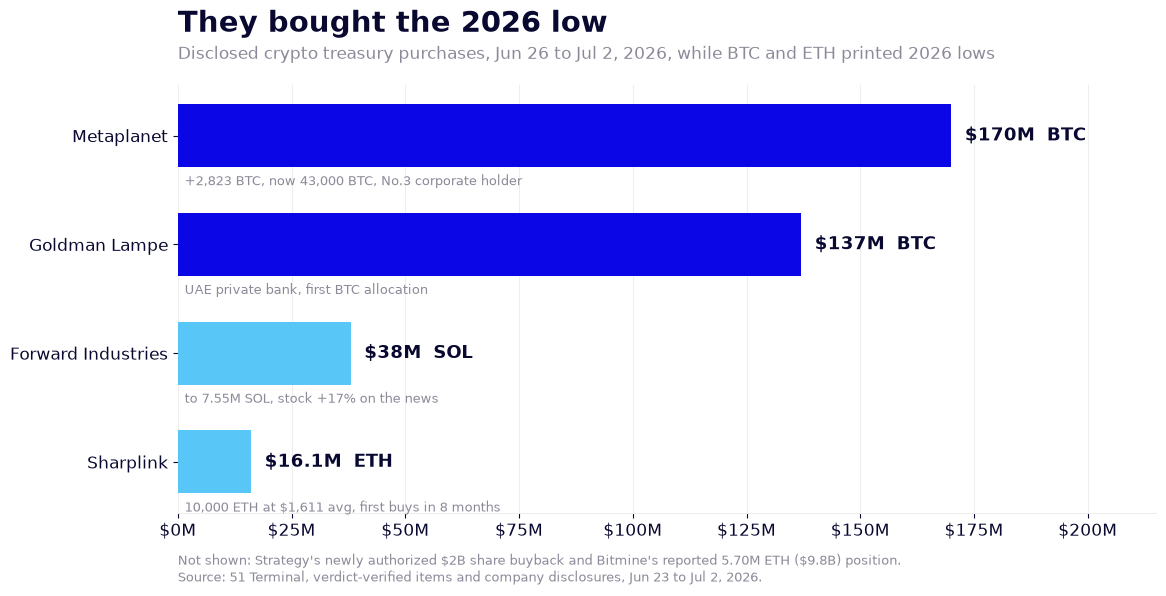
The treasuries bought the 2026 low. While ETH and BTC printed yearly lows this week, the listed digital-asset treasury companies did the opposite of capitulate. Across five trading days, at least six were active accumulators or restructured to keep accumulating, deploying over $360M in disclosed purchases into the bottom.
🚀 Build credibility. Drive pipeline. Win in digital assets. We position you as the authority among 100,000+ digital asset decision-makers who act on what we publish.
Top Boardroom Reads & Data
The Tokenized Asset Market Is $60 Billion. Most of It Isn’t Moving. Forbes, July 2, 2026. $32.9B of the $60B RWA market showed zero weekly transfer activity, the liquidity reality check behind every tokenization pitch deck.
2026: The Year of Tokenized Equities, Sentora Research, June 2026. Tokenized equities hit $5.5B market cap, up 147% YTD, the sector data behind this week’s Robinhood/Securitize/Ondo launches.
Making Stablecoins Stable. IMF Working Paper, 2026. The IMF’s framework for what actually keeps a stablecoin at par, required reading as reserve-sharing models like OUSD change issuer economics.
Global Enterprise AI Report 2026/ Publicis Sapient, June 2026. 1,550 AI decision-makers surveyed: sovereign AI and vendor country-of-origin are now board-level criteria.
140 companies launched a stablecoin that pays them, not the issuer
What happened: Open Standard announced Open USD (OUSD), a stablecoin backed by 140+ launch partners — Visa, Mastercard, Stripe, Coinbase, BlackRock, BNY, Standard Chartered, Google and Shopify among them. Businesses mint and redeem fee-free, reserve income is distributed to participants, and governance is shared across the consortium. Launch is slated for later this year on Plasma and Tempo. Circle closed down 16%.
51 View: The float was the business model, and Open USD just open-sourced it: reserve interest becomes a distribution incentive, the same move airline alliances made against flag carriers. We think the market repriced the wrong company. Circle already shares economics with Coinbase, while Tether keeps roughly all of its float, so a yield-sharing consortium attacks Tether hardest. The catch: consortiums ship slowly. Libra had 28 partners and died of governance; this one has 140.


Circle’s counterpunch: a G-SIB, a custody bank, and a risk engine
What happened: Two days after the OUSD reveal, Standard Chartered and Circle launched the first G-SIB-led integrated access to USDC minting and redemption. BNY expanded its institutional stablecoin servicing with Circle the same week, and BlackRock’s Aladdin added deeper support for Ethena’s stablecoin products, sending ENA up 8%. The fine print: Standard Chartered is also an Open USD launch partner. The banks are buying tickets to every train.
51 View: The integrations are the moat. Once a stablecoin lives inside Aladdin’s risk model and mints through a G-SIB’s own stack, allocation follows the plumbing. Our call: within 18 months a mandate-level allocator holds tokenized cash as a treasury line item simply because the systems already price and custody it. The interesting fight in stablecoins stopped being issuance and became who sits in the risk engine and on the bank rail.
Robinhood turned DeFi into a savings product
What happened: Robinhood launched Robinhood Earn on July 1: users buy USDG, Paxos’ 1:1 dollar stablecoin, and lend it out through self-custody wallets at an estimated 7% APY. Morpho’s credit network runs the lending underneath, Steakhouse Financial curates the vaults, and Robinhood Chain settles it. It’s one of the largest retail DeFi integrations to date, rolling out across Robinhood’s US base over the coming weeks.
51 View: The interesting part is what Robinhood didn’t build. There’s no lending desk and no balance-sheet risk. It plugged a DeFi protocol into a retail app and let the yield flow through, and the user never has to hear the word Morpho. The 7% will compress as money floods in; the architecture is the story. Watch whether Coinbase and Schwab respond, in that order.
Be Smart: Robinhood just showed what “institutional-ready DeFi” actually looks like: the protocol is invisible and the brand carries the trust. If you run a customer-facing platform, the question has changed from “should we touch DeFi” to “which protocol do we plug in, and who curates the risk.”
The stock market went on-chain
What happened: Robinhood launched the public mainnet of Robinhood Chain, an Arbitrum-based L2 with tokenized stock trading live in 120+ countries. The next day, Securitize tokenized its own NYSE-listed stock (SECZ) on listing day, Ondo launched the first custodial tokenized securities in the US — starting with BlackRock’s IVV ETF and Micron, with Broadridge wiring in shareholder voting — and Nasdaq began distributing TotalView order-book data on-chain through Pyth.
51 View: The question of whether stocks go on-chain got answered this week. The open question is whose chain and whose wrapper, and that’s where the Ondo launch matters more than the Robinhood one. Robinhood’s tokens give non-US users access to US stocks. Ondo’s custodial structure keeps the shareholder vote attached to the token, and once a tokenized share still votes, it’s a real security changing venue rather than a derivative wrapped around one. That’s the structure a top-ten asset manager can actually copy, and we’d expect one to offer a natively tokenized share class through it within 12 months.
Be Smart: When tokenized stocks come up, ask one question: “does the token carry the vote?” It instantly separates offshore wrappers from actual securities on-chain, and it’s the distinction the SEC will regulate around.
News Flashes
Infrastructure and Markets
Tradeweb executed a landmark on-chain US Treasuries transaction on the Canton Network, moving real-time tokenized UST settlement from pilot to production.
Anchorage Digital and Binance brought off-exchange settlement to institutional crypto trading, letting institutions trade on Binance while assets stay at a federally chartered custodian.
Regulation and Policy
Taiwan passed a sweeping crypto law with licensing rules, reserve mandates and a bank-first stablecoin framework.
India’s USDT premium topped 8.5% after Enforcement Directorate raids squeezed local stablecoin supply.
Ukraine placed $8.3M of seized USDT under state management for the first time, with plans to convert some into war bonds.
Banking and Payments
Crédit Agricole rolled out EURXT, a euro stablecoin from one of Europe’s largest banks, on MiCA’s first day in full force.
MetaMask launched a Money Account combining stablecoin yield and card spending in one wallet.
Telcoin launched what it calls the first regulated on-chain bank accounts in the US, minting eUSD 1:1 against ACH deposits.
Funds, Deals and Others
Erebor Bank, the Thiel-backed crypto lender, is raising at an $8B+ valuation as deposits nearly quadrupled since March to $4.05B.
SBI Holdings agreed to acquire Bitbank for $288.6M, creating Japan’s largest regulated crypto operator.
Allium raised a $40M Series B (Amplify, Kleiner Perkins) as institutional demand for onchain analytics grows.
The Machine Layer
Palantir’s Karp torched the frontier labs on live TV, and expanded with Nvidia
David Sacks reframed it: AI safety is model-layer choice
OpenAI proposed giving Washington a 5% stake, worth roughly $42.6B
51 View: Karp’s “crash-out” was really a product launch. Palantir will run Nvidia’s models inside the customer’s own stack, so the client keeps the weights, the data and the compute.
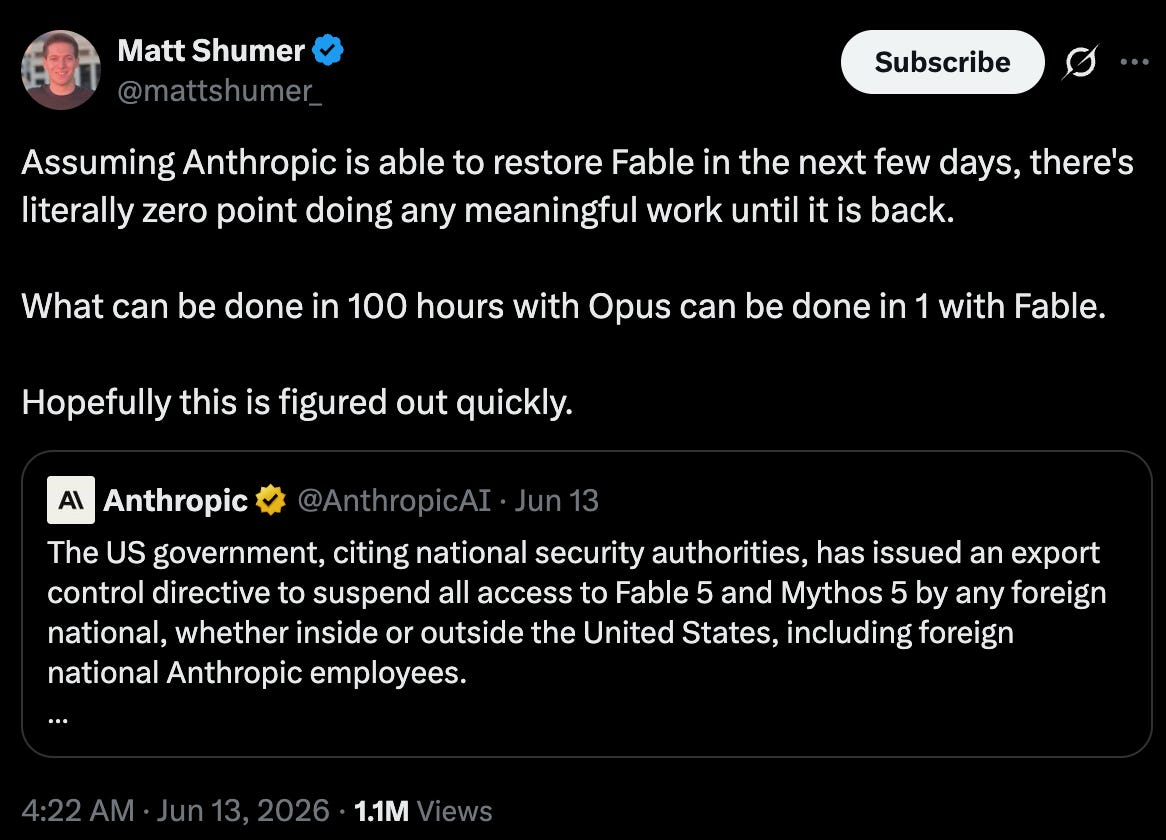
Sacks made the same point from the buyer’s side: whichever model layer you pick can see everything you do with it. And OpenAI just offered the US government 5% of itself to buy political cover. Crypto settled this argument years ago with self-custody. Not your keys, not your coins. The enterprise version is arriving now: not your weights, not your alpha.
Be Smart: The diligence question for any AI vendor is: “who holds the weights, and can you take your data and fine-tuning with you if you leave?” If the answer is no, you’re not a customer, you’re a data source.
One Quick Favor
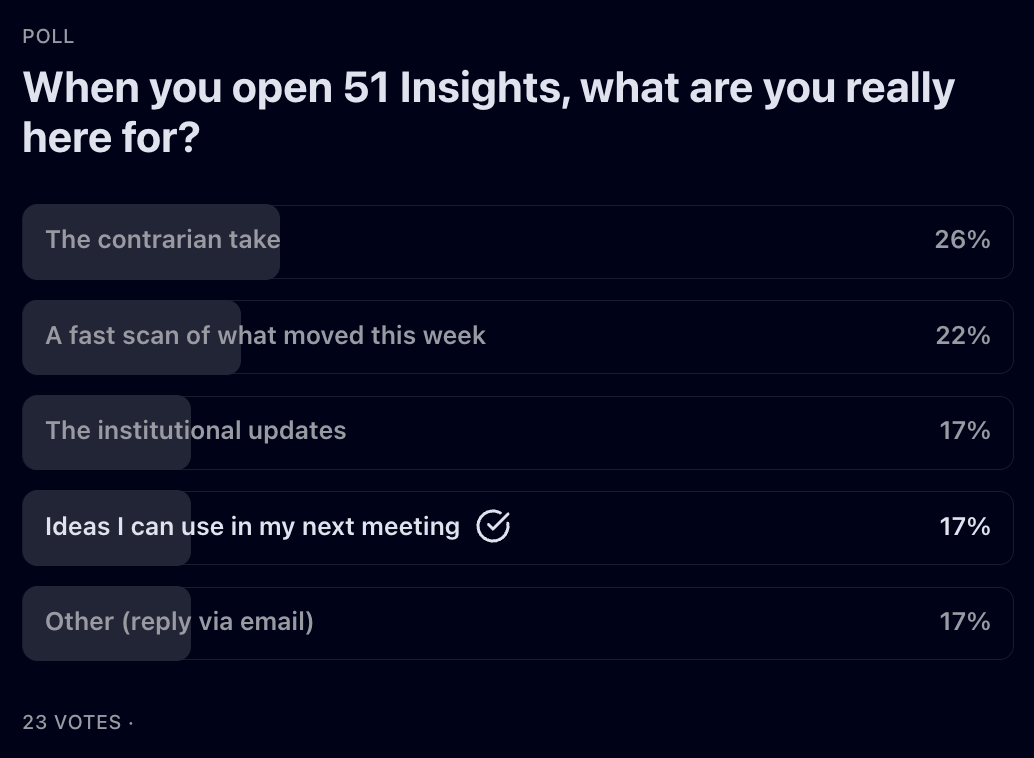
Last week we asked what you actually do with 51 Insights, and the contrarian-take crowd was loudest, so this issue leans into a few. Tell us if we went too far, or not far enough: just hit reply.
That’s all for now, folks.
– Marc & Team


