


Hi, it’s Marc. ✌️
“Waiting and seeing is not a strategy.”
A senior partner and global banking lead at BCG just put a number on the thing every bank CEO is nervous about: up to 15% of bank revenue and 30% of profits at risk by 2035. But the opportunity is bigger than the threat.
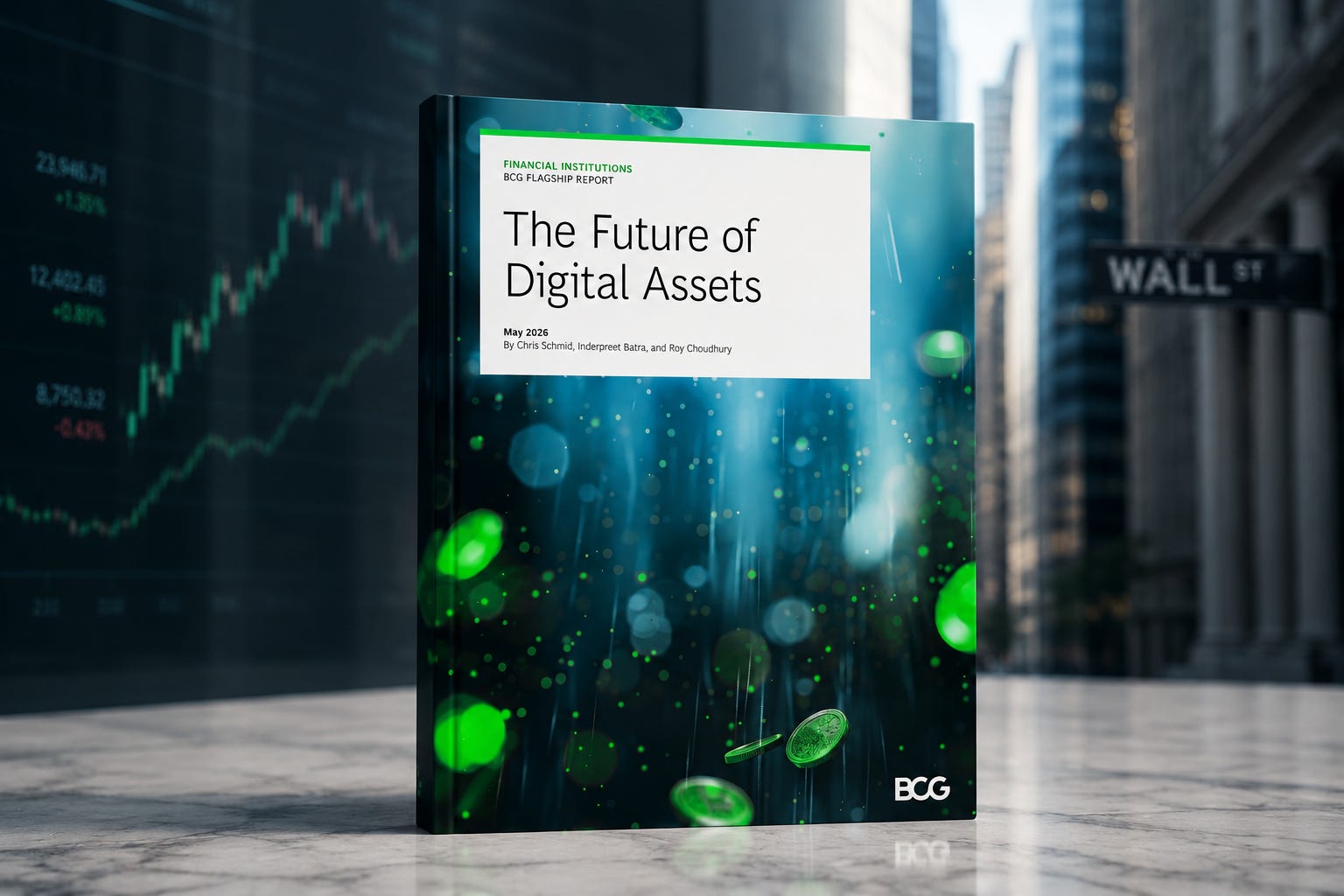
His name is Christian Schmid, Managing Director and Senior Partner at BCG, where he leads the global banking business. He is the lead author of BCG’s biggest ever digital assets report, The Future of Digital Assets.
He calls the whole shift the iPhone of money, and he thinks the real fight is not stablecoins versus deposits. It is who owns the screen the customer taps.
About Christian Schmid: Christian Schmid is a Managing Director and Senior Partner at BCG, based in Zurich, where he leads the firm’s global commercial banking, capital markets and investment banking business and chairs the board of BCG Expand. He trained as an engineer at ETH, came up through IBM, and has spent 27 years advising the CEOs of the world’s biggest banks. He is the lead author of The Future of Digital Assets.
“That’s probably the most interesting topic I have seen in my whole consulting career, which is twenty seven years almost by now.”
Why this matters: This is the year banks stopped watching from the sidelines. The GENIUS Act gave stablecoins a US rulebook, the market is now north of $300B, and the biggest US banks, JPMorgan, Citi and Bank of America, are building a shared tokenized-deposit network aimed at around 2027. BCG puts the tokenization prize near $88 trillion. So when the person who advises these CEOs tells you what he actually thinks, in plain language, it is worth 40 minutes. Here it is in six ideas.
🎯 Jump to the best parts
00:50 Introduction
01:59 Why BCG Published Its Biggest Digital Assets Report
04:13 How Banking Conversations Have Changed
05:46 Is Tokenization Bigger Than Digital Banking?
08:13 Why Banks Could Lose 30% of Their Profits
13:08 Are Digital Assets Replacing Banks?
16:15 The Three Types of Digital Assets
20:08 Where Banks Should Invest
23:20 The Biggest Real World Use Cases
26:00 What Banks Are Actually Doing
27:30 AI vs Digital Assets
30:18 Why Waiting Is Not a Strategy
32:03 Four Futures for Digital Assets
35:14 Stablecoins vs Tokenized Deposits
37:41 The Future of Programmable Money
38:36 Lightning Round
39:50 Where To Learn More
Important Links
BCG profile: https://www.bcg.com/about/people/experts/christian-schmid
LinkedIn: https://www.linkedin.com/in/schmidchristianzuerich
🔒 The full breakdown is for PRO subscribers
Our biggest takeaways from this conversation
1. The threat is real, the opportunity is bigger
Most consultant reports are built to scare you into buying a project. Schmid’s does the opposite. He gives you the scary number, then tells you not to over-index on it.
“Whether this number is completely correct or not is actually a bit irrelevant, I would say. But there is a threat.”
The threat comes in two parts. Banks lose fee income and net interest margin as deposits and transactions drift toward stablecoins. Then they pay again to run two sets of rails at once.
“They also need to maintain the dual rails, which increases the cost base for those banks. And so it’s almost a bit a double whammy.”
The model: up to 15% of revenue and 30% of profit at risk by 2035, versus a world where digital assets barely develop.
The catch he keeps repeating: it is a simulation, not a forecast. The point is the size of the stake, not the decimal.
The upside is the part banks miss. In BCG’s numbers the biggest wins are in asset management and trading. Tokenization makes it easier to wrap more assets, and trading could need less capital and liquidity, which lifts return on equity. BCG pegs the trading upside at up to a 4% RoE bump or $1B+ for an average G-SIB.
What to do with this: don’t argue about whether it’s 30% or 12%. Run the model on your own book. The industry number hides a huge spread from one bank to the next.
Related reads:
→ BCG’s new digital asset playbook: The $88 Trillion Question
This ad could belong to you. 🚀 Build credibility. Drive pipeline and revenue. We position you among 100,000+ digital asset decision-makers.

2. Stop calling it crypto
The word “crypto” hides the most important distinction in the whole report. Schmid splits digital assets into three: tokenized securities, digital money, and cryptocurrency. They are not the same animal, and they don’t have the same future.
“Cryptocurrency per se is a very different thing because it’s not backed with any value, and that’s very different from digital money or digital real world assets.”
Tokenized securities and digital money look a lot like what we already have, just in a new wrapper. In 20 years, he says, no one will care whether a security was tokenized or not.
Cryptocurrency itself he barely grows in the model, roughly 2%. His line: “in today’s world that’s where the money is made,” but it “will not be so significant going forward.”
The bigger point is to stop thinking in use cases and start seeing the technology as one general-purpose thing. That’s the “iPhone of money.”
“The iPhone of money, which combines all the technologies in one thing through the programmability, through DLT.”
What to do with this: when someone says “our crypto strategy,” ask which of the three they mean. If they can’t answer, they don’t have a strategy, they have a headline.
Related reads:
→ 186: banks went on-chain


