


Hey, it’s Marc.
In today’s issue:
Goldman pays up to $2.25B for an income-ETF shop,
Fidelity turns staking into a dividend,
Washington’s agencies lap Congress,
and stablecoins ride the digital pound’s test rails.
One theme runs through all of it: nobody bought exposure this week. Everybody bought income.
Let’s get into it.
PS: This week, we’re testing a new format. Simpler, lighter, sharper. Tell us how you like it at the bottom of the newsletter.
Goldman Buys the Yield, Not the Coin
Coupon clippers.
Goldman Sachs agreed to acquire NEOS Investments for up to $2.25B in cash and equity, its second ETF deal this year.
What’s happening: NEOS, founded in 2022, runs $30B across 19 options-based income ETFs. The one everyone’s watching is BTCI, its bitcoin high-income fund: $1B+ in assets, under 4% of the deal, and an advertised annualized distribution rate around 27%.
Bitcoin trades near $64K, about half its October high.
Ether is down about 37% since January. The 10-year pays 4.65%.
Derivative-income ETFs are already a $180B category, growing 70%+ a year since 2021, per Morningstar data cited by Goldman.
When the price stops paying, investors want the asset to.
Why it matters: Goldman filed its own bitcoin premium income ETF in April. It never launched. Four months later, it agreed to pay up to $2.25B for the firm that got there first.
In ETFs, track record and assets compound. Buying two years of head start beats building. BlackRock’s rival bitcoin income fund launched in June and holds $59M. BTCI holds $1B+. It’s rare to watch BlackRock lose a category, and Goldman is paying to keep it that way.
Between the lines: BTCI’s payout comes from selling options against bitcoin’s price, and part of each distribution can be your own capital coming back. The advertised rate is ~27%; the one-year total return was about minus 42%.
When someone quotes a crypto income ETF’s yield, ask for total return.
Punchline: Wall Street figured out how to charge active fees on a passive asset. Beta compressed to a few basis points; a 27% distribution supports a 0.99% expense ratio. The product being sold is changing from the price to the paycheck.

🚨 Quick plug, then back to the news.
The Goldman story is really a distribution story.
We run the smaller version of that trade for clients every week: 100K+ digital-asset readers, 75% of them decision-makers, the same research that goes into this brief pointed at your category. It produced thousands of qualified leads for clients like BCG, MoonPay or Avalanche.
If your pipeline needs a head start you’d rather not build from zero, here’s how we run it.
Fidelity makes ether pay a dividend
Staking claims.
Fidelity filed to let its $898M ether ETF stake up to 100% of holdings and pay rewards out as quarterly cash distributions.
The details:
The fund keeps 85% of gross staking rewards; 15% goes to the sponsor, custodians, and node operators Blockdaemon, Figment, and Galaxy.
Staking starts only once the SEC declares the filing effective.
Grayscale has staked its ether ETP since October; 21Shares pays distributions; BlackRock’s ETHA still doesn’t stake.
Meanwhile: a record 34% of all ETH is now staked, while ether fell a third from January. And Galaxy’s $125M on-chain yield fund went live with $100M of SharpLink’s ETH treasury, committed in May.
Why it matters: The ETF wrapper keeps absorbing reasons to hold crypto directly. First custody, then options, now the staking coupon, paid in cash like a dividend.
Between the lines: The headline fee stays 0.25%, but 15% of staking rewards is a second toll that never shows up in the expense ratio. At today’s rates, that’s roughly another 0.4% a year if the fund stakes everything.
Looking ahead: Expect every US ether ETF to file the same feature within months. “The fund pays you” is a better pitch than “the fund tracks ether,” especially with ether down 37% this year.
Compare staking ETFs on the reward split, not the expense ratio. The split is where the real fee hides.

Washington’s Agencies Stopped Waiting
Two clocks.
Three moves in five days put the regulators ahead of Congress.
What’s happening:
Majority Leader Thune filed cloture on the Clarity Act, setting a 60-vote test on September 15 to open floor debate.
The SEC scheduled a vote for this morning on proposing “Regulation Crypto Assets,” its first crypto-specific rulemaking. Then it cancelled the meeting hours before the gavel. No reason posted, no new date.
The OCC reported 40 new bank charter applications in 18 months, 13 from digital-asset firms, Kraken and Revolut among them. Comptroller Gould: firms dealing in digital assets “should have a path to becoming a national bank.”
Why it matters: Galaxy just cut the Clarity Act’s 2026 odds from 50% to 30%. So the agencies are building their own regime instead: a proposed offering rule at the SEC, a charter pipeline at the OCC.
For a company, a charter in 2026 beats a statute in 2028.
Between the lines: This morning’s pulled meeting is the tell. Agency timelines can vanish overnight, and what an agency gives, the next administration can take back. Rules reverse; statutes stick. The rational play is the one the industry is making: take the charter now, keep pushing the bill.
Looking ahead: September 15 needs seven Democrats. Watch that count.
Related: 187: Wall Street flipped the switch
Stablecoins ride the digital pound
Plumbing, not an app.
Polygon Labs published details of its test inside the Bank of England’s Digital Pound Lab, run with NOBO Finance and Dun & Bradstreet.
What’s happening: In the experiment, an exporter gets paid on stablecoin rails while the UK importer settles in simulated digital pounds on the Bank’s test system. One payment, both forms of money. No real funds moved; Phase 2 wrapped in July, and findings feed the Bank and Treasury’s digital pound decision later this year.
Why it matters: Central banks spent years framing CBDCs and stablecoins as rivals. The Bank of England’s lab just let a participant team run them in the same payment. That’s a quiet shift.
Between the lines: The Bank’s June draft rules point the same way: a temporary £40B issuance guardrail per systemic sterling stablecoin, and up to 70% of reserves in short-term gilts.
Punchline: The UK design is coming into focus. The central bank settles the core; regulated stablecoins do the reach. A digital pound as plumbing, not an app.
⚡ Quick Hits
Nasdaq agreed to acquire LeveL Markets, the third-largest US ATS, anchoring a new always-on markets unit.
MUFG will test real-time settlement of Japanese government bond repos on Canton, a ~$1.7T market.
Wintermute registered as a US broker-dealer and plans ~$1B of AI and trading-infrastructure spend, per Bloomberg.
Securitize reported Q2 volume of $5.3B, up 147%, in its first earnings report as a public company.
The US Treasury sanctioned Iran-linked exchanges Shelbit and Aban Tether for moving IRGC funds.
The Bank of Russia cleared bitcoin, ether, and USDT for exchange trading, with a proposed retail cap near $3,600/year per broker.
Bybit secured a US court injunction freezing assets from its $1.5B hack after suing North Korea and Lazarus directly.
Anchorpoint, the Standard Chartered-led venture, began rolling out HKDAP, Hong Kong’s first regulated local-dollar stablecoin.
Coinbase made Abu Dhabi its global tokenization hub after winning an ADGM permission covering tokenized securities.
💰 Money Moves
Erebor, the crypto-friendly bank backed by Palmer Luckey, is in talks to raise $1.5B at a $9.5B valuation, six months after launch, per the FT.
NVIDIA partnered with Apollo, BlackRock, Blackstone, Brookfield, Goldman, and KKR on platforms targeting $500B+ of third-party capital for AI compute. MoUs for now, not committed capital. The pitch: treat the GPU like a building that pays rent.
Morgan Stanley launched an initiative to facilitate ~$1.5T of US innovation-infrastructure financing over ten years.
Riot Platforms signed a 20-year, $9.1B lease for 191MW of AI capacity with a frontier AI lab, which Bloomberg reports is Anthropic.
Same instinct across chips and crypto this week: everything becomes an income product.
51 View: The last time tech vendors financed their own customers at scale, it was Lucent and Nortel in the dot-com years. It ended badly.
📚 Boardroom Reads
Stablecoins in Emerging Markets (IMF). South Africa’s dollar-stablecoin trading grew from under ZAR 4B to ZAR 80B in three years.
FCA departs from the traditional stablecoin model (OMFIF). UK issuer capital set at 1% of issuance, half of MiCA’s 2%.
Solana Q2 2026 (Galaxy Research). RWA holdings crossed $3B; public equities now the largest category.
Violent Crypto Wrench Attacks: H1 2026 (Chainalysis). $30M stolen in physical attacks in H1, pacing past 2025’s record.
The AI investment race (BIS). Models AI over-investment at 1.5x the efficient level, against $700B of 2026 capex.
📅 On the Calendar
Date TBD: SEC’s cancelled Regulation Crypto Assets vote; watch for a new Sunshine Act notice
That’s all for now, folks.
– Marc & Team

Ps: Save your spot for our next webinar. Space is limited.
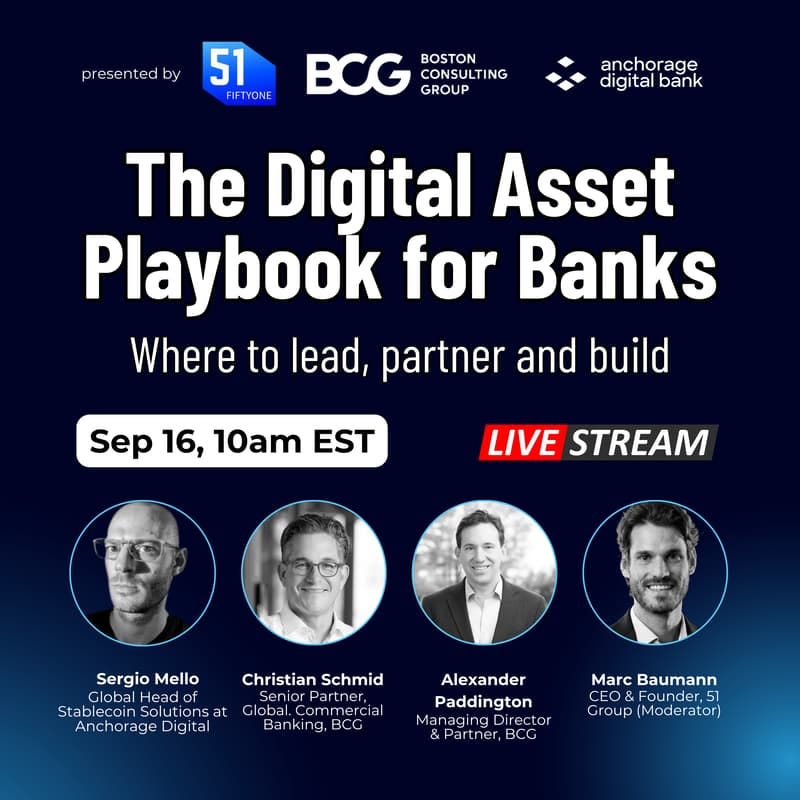
I’m sitting down with the people dvising the banks and building the stablecoin rails those banks will plug into:
Christian Schmid, Managing Director & Senior Partner at BCG, global lead for Corporate & Investment Banking.
Alexander Paddington, Managing Director & Partner at BCG, Global Leader of Transaction Banking
Sergio Mello, Global Head of Stablecoin Solutions at Anchorage Digital
35 minutes of moderated panel. 10 minutes of live Q&A.
For CEOs, board members, and heads of strategy at banks, FMIs, asset managers, and custodians.
📅 September 16 at 10:00 AM ET.
🚨 Space is limited. RSVP to secure your spot.


