Hey, it’s Marc,
I keep coming back to one uncomfortable thought from this week:
Friction may be one of banking’s most valuable assets.
Banks make money because deposits sit still.
Now 3,283 banks want to make those deposits programmable, while AI is getting good enough to manage money without us.
The Dallas Fed ran the numbers: make deposits just 10% more rate-sensitive and banks could lose roughly $700 billion of capacity to hold long-term assets.
That’s the paradox nobody talks about.
We’re building the fastest financial system in history on top of a banking model that depends on money moving slowly.
And this week, both sides accelerated.
In today’s issue:
bitcoin clears $80K after its best week since March 2023,
Nvidia prints a $96B quarter, state bankers associations draft a blockchain for their 3,283 member banks,
and the Trump family’s planned crypto trust bank reveals a 49% silent partner in Abu Dhabi.
Let’s get into it.
PS: Did we hit the bottom yet…? That’s the question I discussed this with with Anthony Bassili, President of Coinbase Asset Management:

📚 Boardroom Reads
Tokenized deposits could affect bank liquidity, maturity transformation (Dallas Fed, Aug 2026). The $700B number every bank board will hear this quarter, with the assumptions behind it.
Stablecoins Meet the Mundell-Fleming Trilemma (New York Fed, Aug 2026). From earlier this month: crisis-country wallets were 1.8% likelier to receive dollar stablecoins the week a currency crisis began.
Keynote remarks at Jackson Hole (Fed Chair Warsh, Aug 2026). The full text of the no-forward-guidance doctrine, 100 days into his term.
On-Chain Taxable Activity (Chainalysis, Aug 2026). $457B of taxable onchain activity in 2025; CARF reporting captures 14% of it.
The Bessent Bounce Does Not Tell the Full Story (Bloomberg Opinion, Aug 2026). Why bonds gave back the buyback rally within 48 hours and bitcoin didn’t.
Bitcoin Trades the Treasury, Not the Halving
Fiscal policy is the chart.
Bitcoin broke $80,000 this week for the first time since May after closing its strongest week since March 2023.
What’s happening: Last week Washington supplied the story: Treasury buybacks, the SEC rulebook, the White House summit. This week the market supplied the money.
Spot bitcoin ETFs absorbed $1.92B in the week ended Aug 22, their best week since October. BlackRock’s IBIT took $1.33B of it. Combined bitcoin and ether ETF inflows hit $2.6B, triple the prior week.
Short sellers lost a record $2.7B in a single day over $4B across the rally.
The bond market gave back the Bessent buyback move within 48 hours: the 30-year yield round-tripped to near a 19-year high. Bitcoin and gold kept their gains. Gross federal debt crossed $40 trillion this month.
Washington kept feeding the tape. Treasury launched “Operation Economic Outcast” against Iran on Monday, designating nearly 60 targets across oil, missile and cyber networks and calling crypto the regime’s sanctions-evasion “tool of choice.”
Our read: the debasement trade and the sanctions trade point the same way. Bigger buybacks show a government managing its own borrowing costs; wider sanctions show banking access used as a policy weapon.
Both strengthen the case for a neutral, scarce asset that now has regulated wrappers. The marginal bitcoin buyer is trading US fiscal policy more than adoption headlines.
Between the lines: Kevin Warsh used his first Jackson Hole speech as Fed chair this morning to warn that inflation is still too high and that he will not tell markets what comes next: “We should not indulge a regime in which market participants are looking primarily to the Fed for their next trade.” A rally built on liquidity hopes now reports to a chair who refuses to feed them.

Quick plug, then back to the news.
Every crypto firm’s pipeline looks great in a week like this. That’s the trap. I’ve watched three cycles, and the firms that only market in good weeks buy their leads at the top.
We build the machine that runs in every tape: positioning, research, campaigns, distribution to 100K+ decision-makers. Avalanche got 700+ qualified leads. BCG got 500+.
Want one? Start here.
Nvidia Makes Compute the New Revenue Line
The other rail.
Nvidia reported $96.2B in revenue for its July quarter on Wednesday, up 106% in a year. Jensen Huang’s one-liner: “Now, compute is revenue.”
The details:
Data center revenue hit $89.0B, up 117%, on the Blackwell Ultra ramp. That is 92% of the whole company.
Guidance: $108B next quarter, above the $104B analysts expected, and it assumes zero data center sales to China. Huang forecast roughly 70% revenue growth for fiscal 2028.
CFO Colette Kress said Nvidia expects the top five hyperscalers to lift capex from about $800B this year to $1.3T next year.
Amazon and Nvidia announced plans for AWS to deploy 2 million additional Nvidia GPUs and adopt its new Vera CPU.
Nvidia returned $26B to shareholders in the quarter and still holds a $99B buyback authorization.
Why it matters: One set of companies is rebuilding the infrastructure of intelligence; another is rebuilding the infrastructure of money. Nvidia shows where the economics accrue in the first: the rail owner keeps 75 cents of gross profit per dollar.
Between the lines: Gross margin is guided down a point on memory costs, and Nvidia is helping finance its own demand through partnerships with BlackRock, Apollo, KKR and others designed to mobilize over $500B in mostly third-party capital. Huang says “the risk is low.” Vendor-adjacent financing at this scale is exactly where past capex booms got into trouble.
Looking ahead: The crypto industry is already migrating toward the AI build-out. NYDIG sold its trading desk this week to focus on 3GW of data-center power. Miners are becoming landlords of compute.
3,283 Banks Get Drafted Onchain
If you can’t ban it, fork it.
Thirty-nine state bankers associations announced the BankChain Alliance on Tuesday: an industry-owned blockchain for tokenized deposits, stablecoins and automated settlement, targeting 2027.
What’s happening: The member associations represent 3,283 banks with $21.8 trillion in combined assets. Former CFPB director Kathy Kraninger is interim chair.
Banks nationwide will be invited to take ownership stakes. A technology partner is still being selected.
It is the third bank-led network in play: The Clearing House’s onchain money project (backed by JPMorgan, Bank of America, Citi, BNY and Wells Fargo) and the Cari network of 30+ regional banks are already building.
The same day, two Dallas Fed economists priced what the technology could cost: if tokenized deposits make depositors 10% more rate-sensitive, banks’ capacity to carry long-term loans and securities could shrink by roughly $700B in 10-year equivalents. If money simply leaves 10% sooner, ~$580B. Back-of-the-envelope, by the authors’ own admission.
Why it matters: The associations just conceded that deposits are going onchain; the only open question is whose chain. The Dallas Fed’s math explains the anxiety.
Be smart: Instant transfers and programmability are what make tokenized deposits competitive. They also dissolve the stickiness bank lending is built on. Smart contracts and AI agents can move deposits without the depositor lifting a finger. The tool that keeps banks in the game also shortens their funding.
Between the lines: No individual bank has publicly committed. No governance, no funding, no tech stack. And three rival consortia are now rebuilding, onchain, the fragmentation problem Swift solved 50 years ago with messaging.
Looking ahead: Watch whether any top-20 bank joins BankChain, or whether this stays a community-bank defense pact against the Clearing House giants.
A Wyoming Bank Beat JPMorgan Out the Door
🚨Save your spot for our next webinar, space is limited.

I’m sitting down with the people dvising the banks and building the stablecoin rails those banks will plug into.
For CEOs, board members, and heads of strategy at banks, FMIs, asset managers, and custodians.
📅 16 September, 10am EST
🚨 Space is limited. RSVP to secure your spot.
The First Family’s Bank Has a Silent Partner
Know your co-owner.
CNBC reported Thursday that a group behind Sheikh Tahnoon bin Zayed Al Nahyan, the UAE’s national security adviser, owns 49% of the holding company for the Trump family’s proposed national crypto trust bank.
The details:
StringZ Holding RSC holds 49% of WLTC Holdings; a Trump family entity holds 38%. WLTC is the parent of World Liberty Trust Company, which won preliminary conditional OCC approval on Aug 14 to issue and custody the ~$4B USD1 stablecoin under federal supervision.
The OCC’s published decision confirms StringZ as an investor with signed commitments not to influence the bank. It does not name Tahnoon or disclose the stake.
Tahnoon’s group already put $500M into World Liberty Financial in January 2025, four days before the inauguration, for a 49% stake. That deal directed $263M to Trump family entities, per the president’s own financial disclosure.
Tahnoon also chairs G42, the UAE’s AI champion, while Washington decides the UAE’s access to advanced US chips.
Why it matters: This is one of the stories keeping the Clarity Act stuck. The bill’s ethics language, restricting officials from profiting from digital assets, exists because of this venture.
The Sept 15 cloture vote needs 60, meaning at least seven Democrats if every Republican holds. Every disclosure like this raises their price.
For institutions there’s a second layer: USD1 would be a federally supervised stablecoin whose ownership runs through a foreign national-security adviser. Compliance teams will read that cap table before treasurers touch the coin.
Looking ahead: Sept 15 is the count that matters. Watch whether Democrats demand divestiture language as the toll.
⚡ Quick Hits
The SEC sent its crypto custody rewrite for investment advisers to the White House, with a formal proposal targeted for October.
HM Treasury will hand the Bank of England a statutory duty to foster stablecoin innovation; the Lords debate it Sept 7 and 9.
Coinbase listed tokenized Apple, Nvidia, Meta and Alphabet on Base, and Bitwise wrapped them into automated portfolios a day later (non-US investors only, 0.15% fee).
Virtu, Tradeweb and M1X completed the first onchain repo backed by a sovereign digital bond, a Marshall Islands issue, settled on Canton in under 10 minutes.
Charles Schwab plans to add Solana, Avalanche and Chainlink for its 39.9M accounts; SOL jumped 11% on the news.
Better and Coinbase made token-backed conforming mortgages generally available to qualifying Coinbase One members; the waitlist represented $260M+ in projected loan volume.
Grayscale launched the first spot Zcash ETF on NYSE Arca at a 2.5% fee, with ZEC at an eight-year high.
Revolut launched its euro stablecoin EURR in Denmark, Poland and Portugal, issued by Stripe’s Bridge, one week before it pulls USDT from its European app.
Japan is moving its stock settlement onto a chain, with details expected in early 2027. We broke it down this week.
PRO stories this week:

💰 Money Moves
Strategy sold $2B of MSTR stock, bought zero bitcoin, and stood up a new $1.59B “USD Cash” pool. Dollar liquidity now ~$6.7B against 840,447 BTC held.
Bitmine reached 5.85M ETH, about 4.8% of all ether, with total holdings of $14.9B after ETH’s 30% week.
BitGo acquired NYDIG’s institutional trading business, roughly 30 staff and 250 client relationships; NYDIG pivots fully to its 3GW power and HPC pipeline.
📅 On the Calendar
Sep 7 & 9: House of Lords debates the Bank of England’s new stablecoin mandate
Sep 9: Treasury’s enlarged $4B long-end buybacks begin
Sep 11: August CPI
Sep 15: The Senate’s 60-vote test on the Clarity Act
Sep 15-16: FOMC meeting; Warsh has put hikes back on the table
Sep 16: Circle’s Arc mainnet goes live
Oct 19: Comments close on Treasury’s GENIUS stablecoin rules
Oct 20: Comments close on the SEC’s Regulation Crypto Assets
That’s all for now, folks.
– Marc & Team

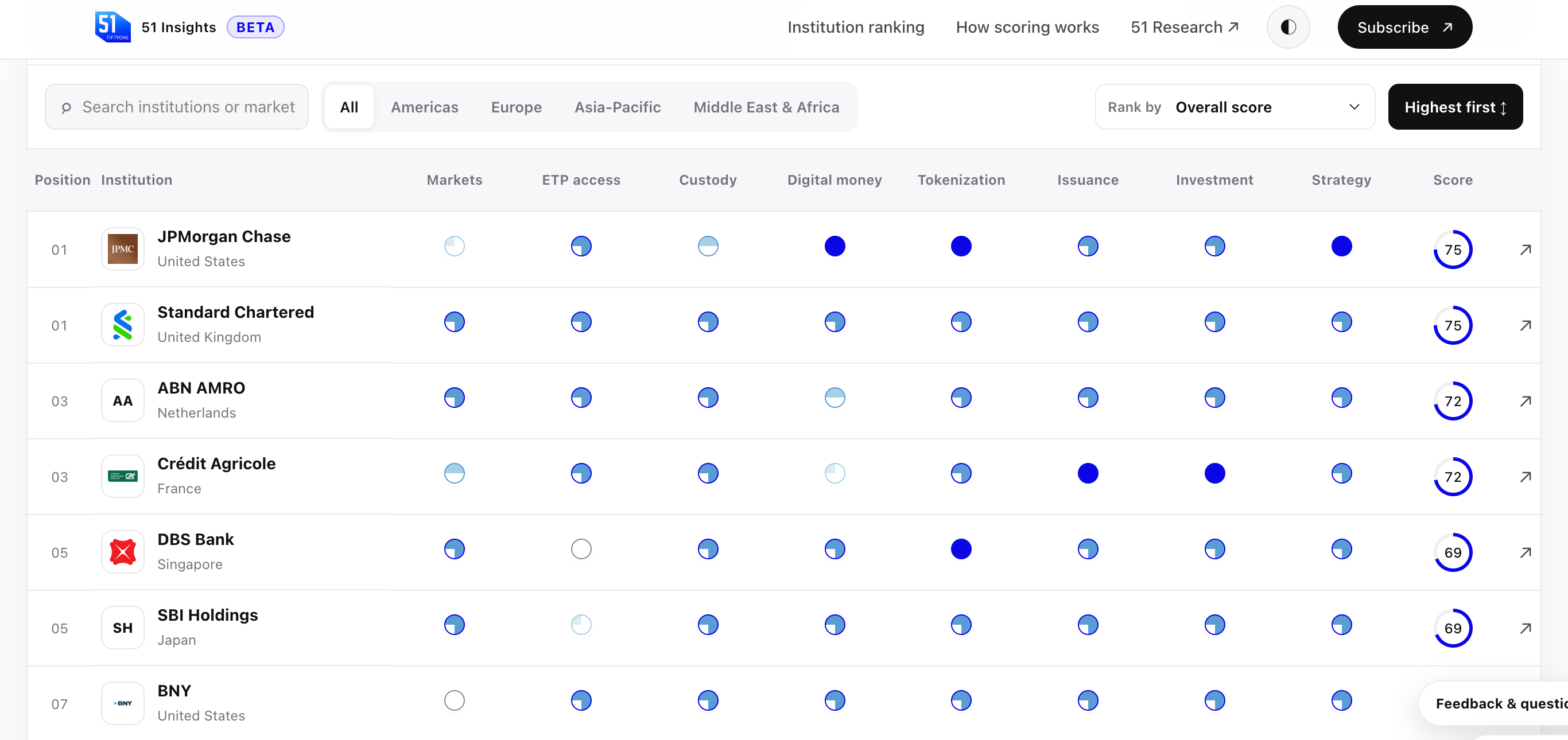
One quick thing: We launched the 51 Institutional Digital Asset Adoption Index. It ranks 103 financial institutions across eight capabilities using linked public evidence. If you want to see which banks are actually live—and which are still piloting—check it out at index.fiftyone.xyz.