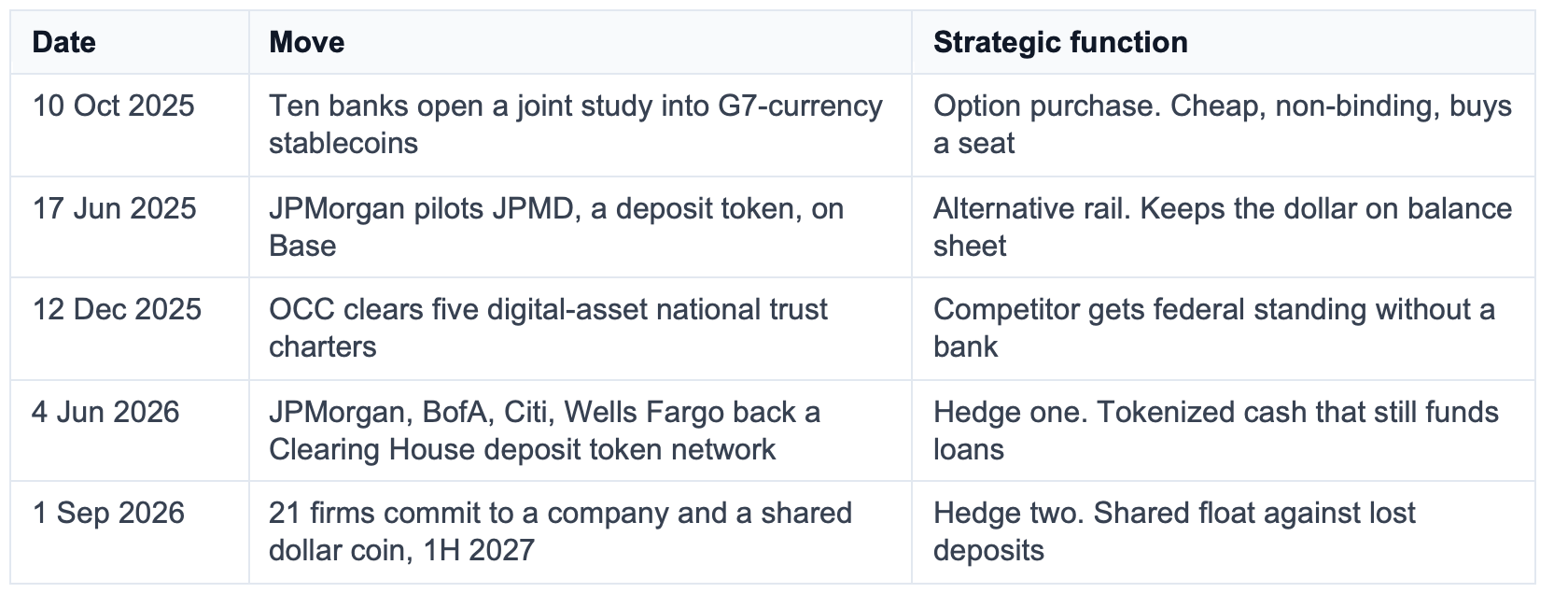
On 1 September 2026, 21 financial firms committed to form a company that will issue one shared dollar stablecoin. Target launch: the first half of 2027. Seventeen of the 21 are globally systemic banks.
Bank of America, Citi, Goldman Sachs, Wells Fargo, UBS, Deutsche Bank, Santander, MUFG and Standard Bank are all in. The company itself does not exist yet. It has no name, no charter, and no chief executive.
THE SIGNAL
Everyone will call this the Tether killer. Read the reserve rules and it looks more like an insurance policy, bought at a steep premium.
PRO Readers: Download the PDF at the bottom.
What Happened
Twenty-one financial firms, 18 of them banks, agreed to set up a jointly owned company that will issue a single dollar-pegged stablecoin. Formation is due in the second half of 2026, subject to closing conditions. The coin itself is targeted at the first half of 2027, with a euro version named as the next priority. Reuters first reported the commitment.
This is the same project that ten banks opened as a study on 10 October 2025. Back then the group described a 1:1 reserve-backed form of digital money for G7 currencies. Eight of those ten are still here: Santander, Bank of America, Citi, Deutsche Bank, Goldman Sachs, MUFG, TD and UBS.
Barclays and BNP Paribas are not on the September roster. Ten new names take the count to 21: Wells Fargo, BBVA, Capital One, Commerzbank, Credit Agricole, Lloyds, PNC, Scotiabank, Rabobank and Standard Bank. Under the GENIUS Act, a payment stablecoin holds reserves 1:1 in cash, Treasury bills and repo. The same law bars issuers from paying holders any interest or yield.
Why It Matters
A deposit funds a loan. A stablecoin reserve does not. That gap has a price.
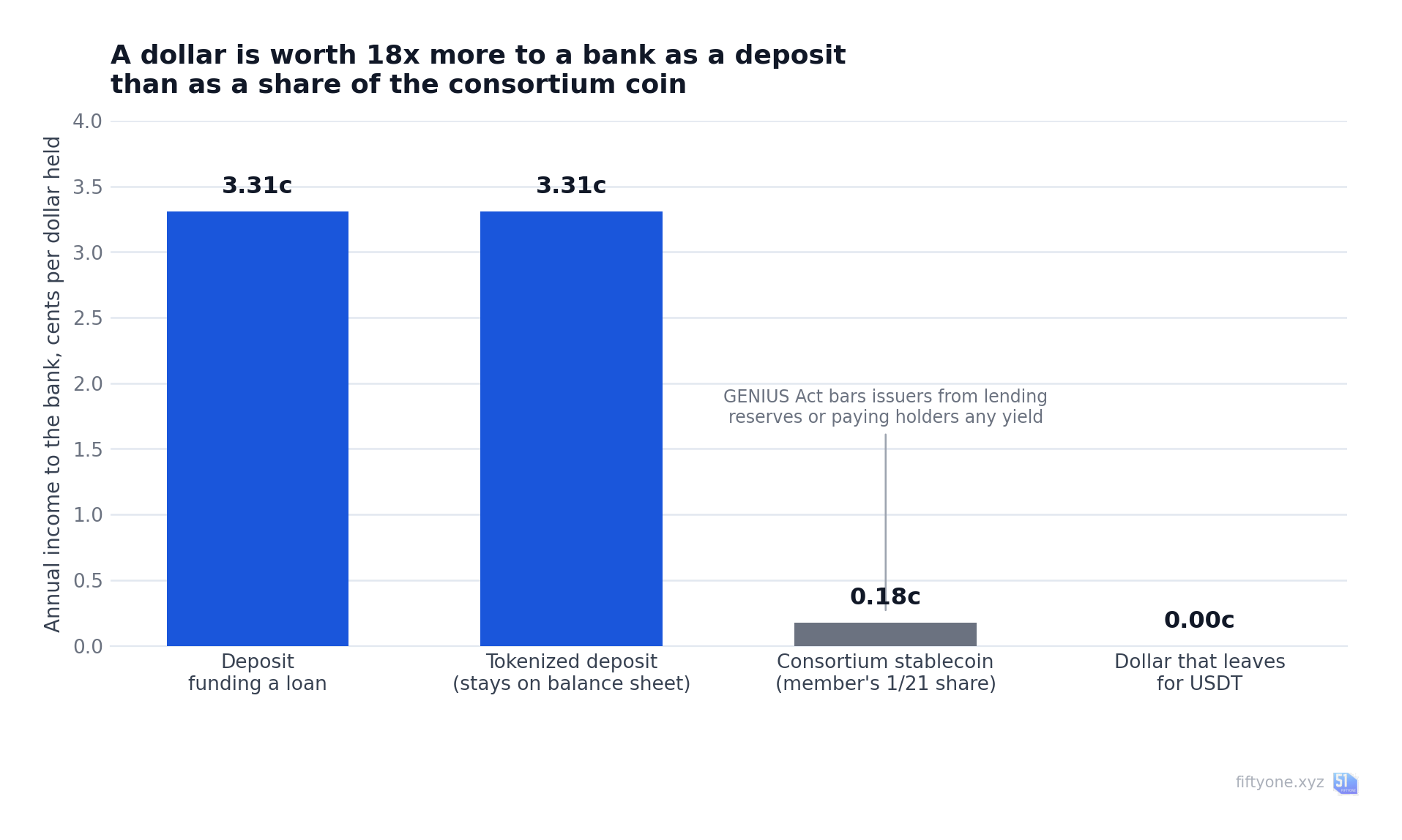
The FDIC put the industry’s net interest margin at 3.31% in the first quarter of 2026. So a dollar of deposits earns a bank about 3.31 cents a year.
Move that dollar into the shared coin and it earns the three-month bill instead, 3.73% in July 2026. Nothing gets lent against it. Then split that income across 21 owners and each member’s take on the dollar is 0.18 cents. Same dollar, about one eighteenth of the income.
Derivation: FDIC Quarterly Banking Profile Q1 2026 aggregate NIM 3.31%. FRED TB3MS July 2026 3-month bill 3.73%. Member share assuming equal ownership: 3.73% / 21 = 0.178% = 0.18 cents per dollar per year. Ratio to a deposit dollar: 3.31 / 0.178 = 18.6x.
Two caveats. Equity splits are not public, so equal shares is our assumption. And the figure is gross of the venture’s running costs, so 0.18 cents is a ceiling, not a forecast.
The counterargument is real, and it is why 21 boards signed.
Compare the coin to a deposit and it reads as a loss. Compare it to the dollar walking out the door and it reads as a save. A dollar that leaves for USDT earns the bank nothing at all.
Tether cleared more than $13 billion in 2024 and more than $10 billion in 2025. That was float which used to sit in bank accounts. USDT is near $183 billion today and USDC near $74 billion, together about 85% of a $303 billion market (CoinGecko, 29-30 August 2026). So against zero, 0.18 cents is a win. Nobody buys insurance expecting to profit.
The non-obvious part: the same banks booked two rooms.
On 4 June 2026 the Wall Street Journal reported a second project. JPMorgan, Bank of America, Citi, Wells Fargo and a dozen more are building a shared tokenized deposit network. The Clearing Houseruns it. Target launch: the first half of 2027.
Same window as the stablecoin. And the rosters overlap: Bank of America, Citi, Wells Fargo, PNC, Santander and TD sit in both. JPMorgan’s absence got the headlines. The overlap is the better story.
A tokenized deposit stays on the bank’s own balance sheet, so the dollar keeps earning its 3.31 cents. A shared stablecoin does not, so it earns 0.18. They are funding both because they cannot tell you which one the treasurer will pick. Owning both answers is cheaper than guessing wrong.
JPMorgan’s absence makes sense
It already runs JPMD, a dollar deposit token. That went live on Base for institutional clients on 12 November 2025. Deposit tokens can pay interest. Stablecoins, under GENIUS, cannot.
“From an institutional standpoint, deposit tokens are a superior alternative to stablecoins,” said Naveen Mallela of JPMorgan’s Kinexys unit. “Because they are based on fractional banking, we think it is more scalable.” Strip the diplomacy and the claim is about the balance sheet. JPMorgan is not refusing to share the float. It is refusing to give up the loan.
THE 51 SCOREBOARD
What we said (10 October 2025, Banks Come For Tether): the ten-bank G7 project was “the most bullish stablecoin news of 2025” and, if it executed, “a huge, credible threat to Tether and Circle.”
What happened since: the group committed, grew to 21 firms and set a date. It also lost Barclays and BNP Paribas, still has no company, no name and no charter, and will not ship for another year. USDT supply went up, not down.
Verdict: early. One correction to that note: Tether’s 2024 profit was more than $13 billion per its own Q4 report, not $14 billion.
🚨Save your spot for our next webinar, space is limited.

I’m sitting down with the people dvising the banks and building the stablecoin rails those banks will plug into.
For CEOs, board members, and heads of strategy at banks, FMIs, asset managers, and custodians.
📅 16 September, 10am EST
🚨 Space is limited. RSVP to secure your spot.
Strategic Timeline: How the Banks Got Here