



You know what’s more powerful than a 1,000-page regulation? A two-page FAQ.
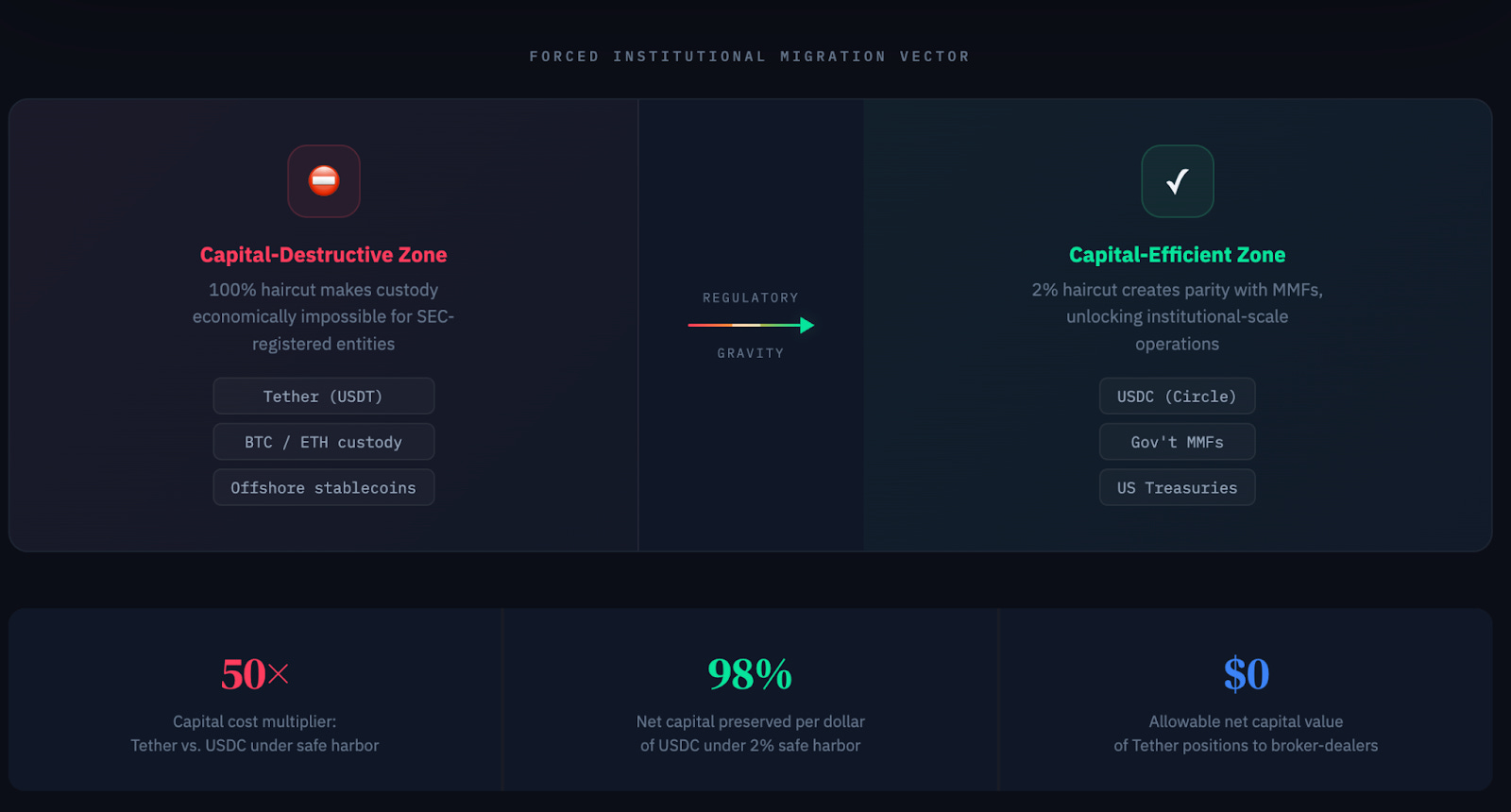
On February 19, the SEC’s Division of Trading and Markets quietly dropped guidance that slashes the capital charge on stablecoins from 100% to 2% for broker-dealers.
That’s the same haircut as money market funds. This makes stablecoins near-cash working capital and it might be the single most important regulatory shift for Wall Street in 2026. [RELEASE] [FAQs]
👉PRO: Download the PDF at the bottom
👉Need it simple? Read my post here.
What happened
The SEC issued an FAQ clarifying that broker-dealers can now apply a 2% capital haircut to qualifying payment stablecoins under Exchangule 15c3-1, the net capital rule that governs how much liquid capital Wall Street firms must hold. [RELEASE]
But there’s a catch: the “no-netting” sting. The 2% charge applies to the gross market value of the greater long or short position, preventing delta-neutral offsetting. To qualify, stablecoins must meet strict GENIUS Act criteria: U.S.-regulated issuers, 100% USD/T-bill backing, and monthly AICPA-standard attestations.
Zooming in: Under Rule 15c3-1 (Net Capital Rule), broker-dealers must apply risk-based “haircuts” (deductions) to balance sheet assets when computing regulatory net capital, ensuring liquidity buffers against potential losses. Previously, most stablecoins lacked “ready market” status, triggering a 100% haircut that excluded them entirely from capital calculations.
Here’s the math and why it’s a big deal:
→ A 100% haircut means a firm holding $100M in stablecoins counts $0 toward capital. Every dollar of stablecoins was dead weight.
→ A 2% haircut means that same $100M counts as $98M.
Be smart: Qualifying stablecoins must be USD-denominated, backed by cash/short-term Treasuries (per 12 U.S.C. 5903 standards), issued by regulated entities (e.g., state money transmitters), with public redemption policies and monthly CPA-attested reserves; post-GENIUS Act, they align with that law’s “permitted payment stablecoin” definition.

Why 2%: The logic is simple. Stablecoin reserves are T-bills, cash, and short-duration government paper: the exact same assets sitting inside a government money market fund.
Commissioner Hester Peirce called the old 100% charge “unnecessarily punitive.” The 2% captures residual redemption risk, operational risk, and potential de-peg scenarios, but treats stablecoins as fundamentally low-risk.
What they’re saying:
“Stablecoins are essential to transacting on blockchain rails. Using stablecoins will make it feasible for broker-dealers to engage in a broader range of business activities relating to tokenized securities and other crypto assets.”
– SEC Commissioner Hester M. Peirce
And the downstream effect is massive. If broker-dealers can hold stablecoins cheaply, they can
settle trades on blockchain rails
offer tokenized securities
move money 24/7 instead of waiting for banking hours.
Devil’s advocate: Of $35T in 2025 stablecoin volume, only $390B represents genuine economic activity (remittances and payroll), while 92% of stablecoin volume remains crypto trading.

The analysis that follows is for PRO subscribers.
You just saw the rule change. What you haven't seen is who wins, who's dead, and how to position before the rest of the market catches up. PRO ONLY:
Why it matters (instant settlement unlock, USDT kill switch, the netting catch, banks terrified)
Investor Alpha (Circle, Coinbase, onshore challengers, allocator advice, M&A wave)
Watchlist + Full PDF
