Another week, another story. There’s as lot of buzz about Grayscale Bitcoin Trust (GBTC), its connection to FTX, DCG (Digital Currency Group), Three Arrows Capital (3AC), and Genesis, its dangerously low discount rate and its risk of being liquidated. It’s pretty entangled. I dug into some of the details on how it all works:
GBTC is the world’s largest cryptocurrency fund, owning about 3.5% of the world’s Bitcoin (643’572 BTC). Since its inception in 2013, it has attracted a large amount of institutional investors.
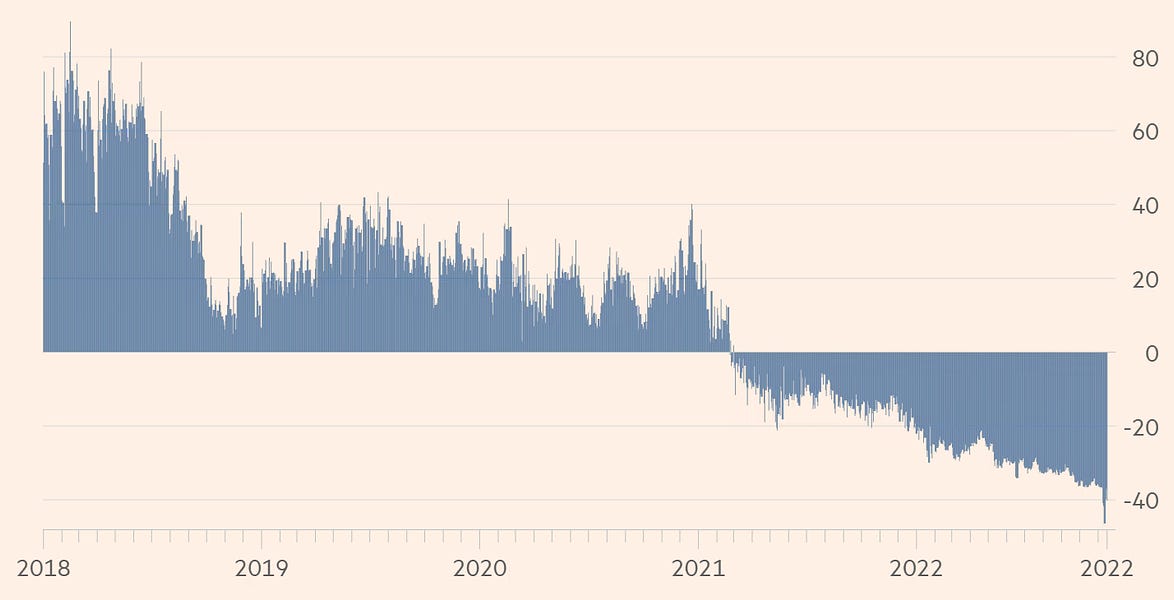
Investors don’t receive bitcoin (BTC) but shares representing BTC. GBTC buys and stores the underlying BTC (apparently at ) and takes a 2%/year management fee. At the moment, GBTC holds 0.00091487 BTC per share. With Bitcoin at around $15’600 it should trade at roughly $14.27. Instead, it closed yesterday at $8.50, a 42% discount.
During the bull market, GBTC was trading at a premium. For institutional investors, it was one of the few ways to get exposure to Bitcoin. Increased options for BTC exposure, new Bitcoin spot ETFs (except in the US), a bull market turned bearish, and the recent short-term price pressure from the FTX contagion all decreased the demand in GBTC, as institutions sold their (semi-)liquid assets. Its premium decreased.
While GBTC was trading at a premium, folks were buying BTC on the market, sending it to the trust in exchange for shares, then selling the shares to capture the premium. Now, as it’s trading at a discount, you could gain exposure to $1 of Bitcoin with 60 cents of GBTC – So why isn't everyone doing it?
Because the opposite is NOT possible: Investors cannot redeem shares for BTC and sell it in the market to arbitrage the discount away (as publicly specified in the Trust agreement). GBTC does not allow redemption. Investors can only sell the shares at a loss against USD. This is why GBTC trades at a discount.